
The “Death Railway” in Kanchanaburi, Thailand, a significant site from World War II, has been revealed after remaining submerged under a reservoir for decades. The draining of Vajiralongkorn Dam for maintenance exposed remnants of Nithe Station, prompting historians to examine the site for artifacts and historical verification. This railway, built as a Japanese supply route, witnessed immense suffering, with thousands of Allied POWs and Asian laborers sacrificing their lives during its construction.
A Uniquely Timed Discovery
The fleeting window for research arises as the reservoir is set to refill with the rainy season, posing a challenge to those working on the site. Visitors, including local residents, are capturing the sight and sharing it widely. Nithe was a major point on the railway, connecting Thailand, known then as Siam, with Myanmar, formerly Burma. Approximately 60,000 POWs from various Allied nations and hundreds of thousands of Asian laborers were forced to work under harsh conditions, resulting in thousands of deaths.
Historical Significance and Cultural Impact
Referred to as the “Death Railway,” it was featured in films such as “The Bridge on the River Kwai” and “The Railway Man.” The railway’s story inspired literary works like “The Narrow Road to the Deep North,” now adapted into a series. Researchers are grasping the opportunity to study the station’s emersion. Independent researcher Martyn Fryer arrived from Perth, Australia, to explore the site where his grandfather, a POW, died.
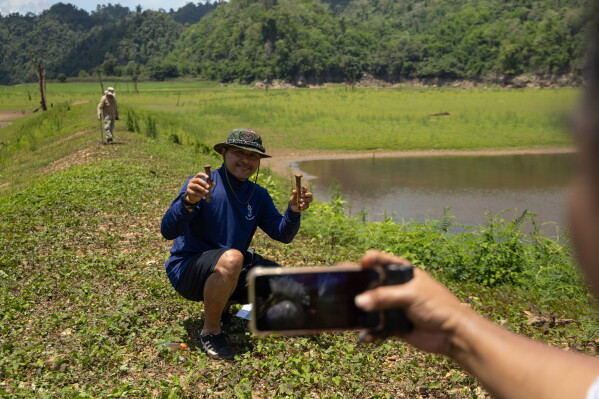
Fryer braved harsh conditions, motivated by a desire to connect with the past. He utilized a metal detector to discover war artifacts such as iron dog spikes and bridge staples. Despite previous visits hampered by high water levels, this moment provides unprecedented access to remaining structures. Andrew Snow, a researcher with the Thailand–Burma Railway Centre, uses historic photographs and maps to locate POW camps, aiding this research initiative.
Global Visitor Interest
The uniquely low water levels this year good conditions for examining Nithe’s infrastructure. Hundreds have visited, like local resident Kitti Laokham, whose online posts have attracted significant viewership. Visitors like Channarong Noimala traveled from Bangkok to pay respects to those who perished during the railway’s construction.
Preservation of War History
Nearby, Hellfire Pass stands as a testament to the sacrifices made by POWs. Managed by an Australian veteran, the Hellfire Pass Interpretive Centre aims to preserve personal wartime stories, drawing attention to the enduring impact of war. Marked by the 80th anniversary of World War II’s conclusion, the center has seen record visitation. It serves as a vital link between families, nations, and historic events, focusing on Australia’s wartime experience and honoring those who served.