
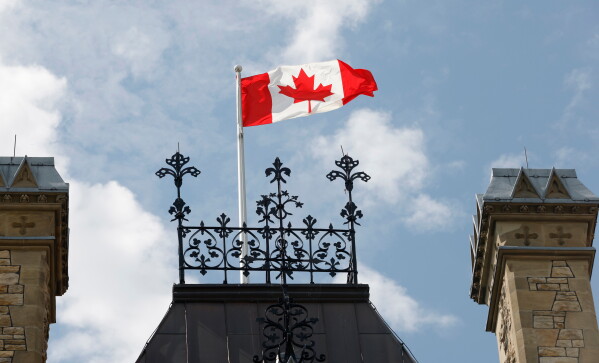
Mark Carney gained attention internationally as Canada’s prime minister by urging that middle powers should resist economic coercion from more dominant nations. This stance is now being tested by President Donald Trump, who implemented sweeping new tariffs on Canadian goods. This move raises the question of Canada’s capacity to endure economic hardship.
Negotiations deteriorated on Friday when Canada withdrew, citing Carney’s decision that the U.S. was demanding excessive concessions for tariff relief. Consequently, on Saturday, the U.S. enforced 50% duties on approximately $20 billion worth of Canadian imports. Carney announced a dollar-for-dollar retaliation starting September 8. “We’re going to hit back,” stated Carney.
Carney’s approach diverges from that of other American allies who have evaded economic pain by conforming to tariff pressures. His actions present the clearest test of his philosophy that middle powers should stand firm against economic threats from global powers like the U.S. and China, even at a cost. Canada’s response demonstrates how nations navigate an era where traditional alliances provide less security and economic relationships themselves are used as leverage.
The trade conflict has also become a question of sovereignty. Carney revealed that Washington introduced language late in the negotiations that would limit Canada’s ability to make trade agreements with other countries. He termed this demand “unacceptable” and “a question of sovereignty.” British Columbia Premier David Eby warned that acquiescing would reduce Canada “to the economic equivalent of the 51st state,” a notion Trump frequently muses about. Canada thus emerges as a test case for the world Carney foresaw.
Carney emphasized the international order was facing “a rupture, not a transition,” and sovereignty would increasingly rely on a country’s ability to “withstand pressure.” Middle powers, he argued, are negotiating from weakness when alone against great powers.
Trump later stressed Canada’s dependency on the U.S. by saying, “Canada lives because of the United States.” He accused Canada of imposing significant tariffs on U.S. farmers for years, stating, “No more!” Seven months after Davos, Canada’s situation exemplifies the world scenario Carney described.
Carney accused Washington of using “economic integration as a weapon” and said its “signature was written in pencil.” According to historian Robert Bothwell, Canada is particularly vulnerable to U.S. pressure. “No country is more exposed than Canada,” Bothwell said. Success for Canada would mean retaining independence despite pressures to subordinate it.
Canada’s reliance on the U.S. market complicates matters since nearly three-quarters of its exports are destined for the United States, with their economy being much larger. Substituting the U.S. market is considerably challenging. Carney admitted retaliation would lead to higher costs and fewer choices for Canadians.
The U.S. Trade Representative Jamieson Greer disputed Canada’s narrative of the negotiations falling apart, accusing Ottawa of introducing new demands and reversing commitments after Washington proposed tariff reductions on several items. The possibility of further escalation remains as the U.S. plans additional measures in retaliation to Canada’s actions.
The European Union previously prepared retaliatory tariffs against the U.S. but suspended them while negotiating with Washington. Political science professor Nelson Wiseman noted that Canada offers the biggest test yet of whether Carney’s strategy could work and if resistance by one middle power could influence others.
Ian Bremmer, president of the Eurasia Group, noted Americans underestimate the level of Canadian anger towards the Trump administration. This sentiment became evident at sports events over the weekend, with fans booing the U.S. national anthem during Major League Soccer matches.
Manitoba Premier Wab Kinew stressed the need for Canadians to prepare for a prolonged dispute, suggesting Trump might emerge weaker after the midterm elections. “We should be prepared to duke it out for two years,” Kinew insisted, hoping for a return to normalcy.
Carney views this confrontation as a critical test of whether Canada can maintain its independence under U.S. pressure. “I warned that America is trying to break us so that they can own us,” Carney asserted. “We are keeping that promise.”