
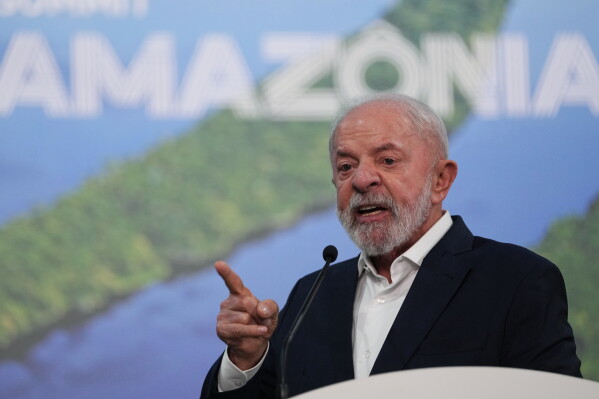
Brazil’s Supreme Court is gearing up to address several pivotal cases that could significantly affect the Amazon rainforest and the Indigenous communities relying on it. These cases include issues related to Indigenous land rights, recent environmental protection reversals, and infrastructure projects.
The backdrop of these legal battles is a predominantly conservative Congress, which has greenlit actions perceived by environmentalists as infringing on constitutional rights. President Luiz Inácio Lula da Silva’s administration, focused on environmental sustainability, has tried to counter these measures. Despite vetoing several bills, the legislature overcame these vetoes, leading to the Supreme Court becoming a decisive judicial arena.
Suely Araújo, a policy coordinator at the Climate Observatory, commented on the political dynamics, stating, “The government is very weak in the legislative arena. It often opposes anti-environmental bills, but it lacks the political strength to persuade Congress to vote with it.” This underscores the difficult landscape the Lula administration navigates, facing strong agribusiness influence in Congress.
Agribusiness remains a dominant force, with Congress leveraging control over the federal budget and driving through proposals that weaken environmental policies. As a result, the Supreme Court has become crucial in safeguarding parts of Lula’s environmental objectives.
Brazil stands as a major global player in soybean and beef production. In early 2026, China, Brazil’s largest trading partner, imported a significant portion of these exports. The drive to expand Brazil’s agricultural frontier, particularly for cattle ranching and soybean cultivation, continues to challenge environmental conservation efforts in the Amazon.
The Parliamentary Agricultural Front has not provided remarks on these issues. Agribusiness entities, however, assert their opposition to illegal deforestation and emphasize enhanced agricultural yield alongside decreased forest clearing.
Preserving the Amazon is vital for climate regulation. It plays a critical role in controlling climate and precipitation patterns and stores significant carbon amounts that, if unleashed, could escalate global warming.
Indigenous Land Rights Under Review
On Friday, Brazil’s Supreme Court revisited motions pertaining to its 2025 ruling against the “time limit” thesis, a controversial legal notion proposing limits on Indigenous land claims. This idea, backed by the agribusiness sector, would confine claims to territories occupied or legally disputed in 1988 when the Constitution was enacted. Indigenous groups contend that this overlooks historical displacements.
The court is evaluating submissions from diverse parties, including government entities, political parties, farmers, and Indigenous organizations. The justices are expected to rule on compensation protocols and deadlines for Indigenous land demarcation completion by mid-August.
Ricardo Terena, from the Articulation of Indigenous Peoples of Brazil, highlighted potential barriers to land demarcations under new proposals. These could introduce additional administrative layers and expanded compensation rights for non-Indigenous occupants.
Upcoming Decisions on Amazon Governance
On an impending Wednesday, Brazil’s top court will also consider two more pivotal cases: the state laws ending the soy moratorium and a new law expediting licenses for infrastructural projects.
Earlier in January, major grain traders exited the soy moratorium, a longstanding agreement recognized for lowering deforestation in the Amazon by prohibiting soy cultivation on cleared land. This accord came apart after leading soy-producing states annulled tax benefits for participating firms. Justice Flávio Dino issued an injunction suspending these state laws, pending the full court’s scrutiny.
The Supreme Court will deliberate on challenges to the new environmental licensing law that was implemented in February. This law simplifies permit approvals for high-impact projects, such as mining, highways, and industrial plants.
Suely Araújo of the Climate Observatory anticipates the court will invalidate certain unconstitutional aspects of this law. These include self-licensing for medium-impact projects. She noted tangible effects of this law in the Amazon, referencing a controversial highway’s paving and river dredging plans without thorough prior evaluation.
The environment ministry defends the soy moratorium, crediting it with reduced Amazon deforestation while boosting Brazil’s production capacity. Concerning the environmental licensing law, the ministry acknowledged attempts to veto problematic sections and expressed the need for maintaining minimum national standards.
The ministry stated, “Brazil needs an environmental licensing system that is more efficient, predictable, technically robust, and capable of addressing the challenges of an economy that must expand infrastructure investment while confronting climate change and biodiversity loss.”