
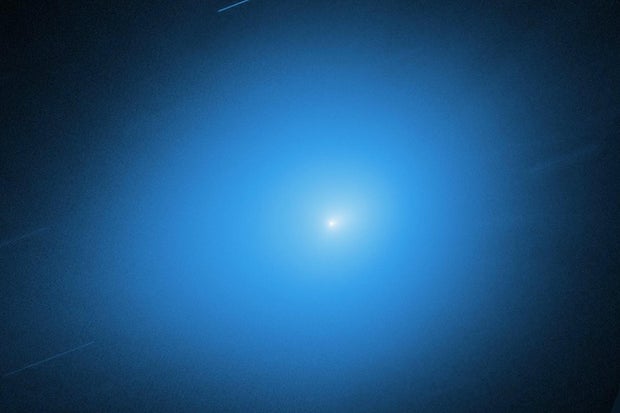
On June 22, 2026, astronomers shared intriguing insights into an interstellar comet termed 3I/ATLAS. This comet, observed last year, may be three times older than our solar system and provides a unique opportunity for scientific study.
Unprecedented Observation
3I/ATLAS is the third known comet from beyond the solar system, offering a chance to analyze its brightness and composition. Scientists first noticed it in July 2025, sparking discussion online. A Harvard researcher posited it could be an alien spacecraft, but NASA refuted this claim.
Age and Composition
Recent studies suggest 3I/ATLAS could be up to 12 million years old, contrasting sharply with the solar system’s estimated age of 4.5 billion years. Lead author Martin Cordiner of NASA’s Goddard Space Flight Center commented, “Maybe it’s the oldest object ever observed in our solar system.” The comet’s chemical composition, examined by telescopes like the James Webb Space Telescope, reveals isotopes unfamiliar in the solar system’s bodies. Its deuterium levels, particularly high compared to solar system comets, indicate it formed in extremely cold conditions, possibly as cold as minus 243 degrees Celsius.
Origin and Trajectory
While 3I/ATLAS’s origin remains uncertain, research suggests such interstellar comets arise similarly to solar system comets, ejecting during planet formation. The comet likely spent billions of years navigating vast trajectories across the galaxy. Its lack of chemical enrichment hints at formation near emerging stars. It could be a relic from “cosmic noon,” a period about 10 billion years ago marked by star birth.
Comparison to Other Comets
Former interstellar objects, 1I/’Oumuamua from 2017 and 2I/Borisov from 2019, lacked sufficient brightness to gather similar isotopic data. NASA released images last November showing 3I/ATLAS 180 million miles from Earth, with additional captures from Mars orbiters highlighting its movement.
Skepticism and Discovery
Harvard professor Avi Loeb expressed skepticism, reminiscent of his views on ‘Oumuamua, suggesting it warrants exploration of various possibilities until more data emerges. NASA maintains there’s no evidence of extraterrestrial life, and SETI concurs regarding the lack of alien technology.
Future Prospects
Although challenging, astronomers expect future interstellar object discoveries through facilities like the Vera C. Rubin Observatory in Chile. Astronomers not involved in the study described it as groundbreaking, with potential for expanded understanding of galactic phenomena. Martin Cordiner encapsulated the sentiment: “This is just the beginning of an exciting new field. We’ve got a lot more to learn about these things—and what they can tell us about our galaxy.”