
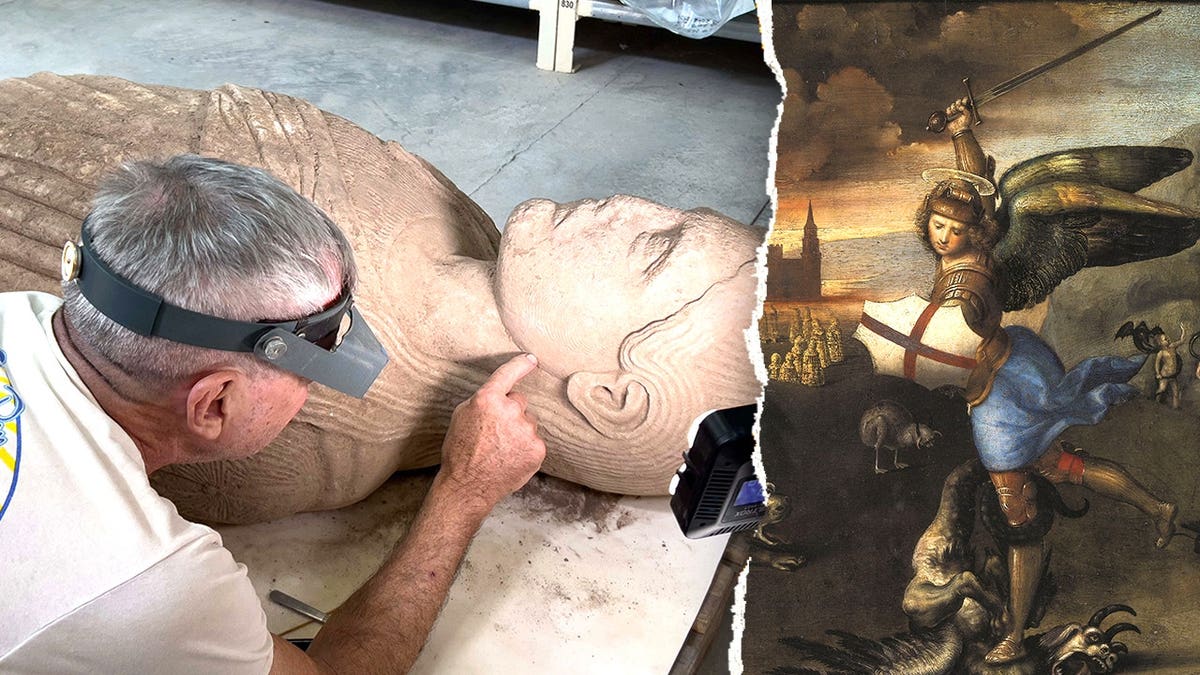
An ancient marble statue dating back 2,500 years has been discovered in the ruins of Sardis, an historic city referenced in the Book of Revelation. The statue was uncovered by excavators working in the Salihli district of Manisa, Turkey, approximately 45 miles from İzmir. This discovery was recently announced by the Turkish Ministry of Culture and Tourism.
Images from the archaeological site display the careful excavation of the statue, which remarkably preserved its facial features. The statue, depicting a young man, stands about 7.2 feet tall. Turkish Culture and Tourism Minister Mehmet Nuri Ersoy called the sculpture an ‘extraordinary discovery’ in a recent social media post.
Historical records reveal the statue was repurposed as paving along a colonnaded street during Roman times, lying face-down and thus preserving its details. Minister Ersoy highlighted the distinct details in the statue’s clothing, which reflect Lydian cultural influences.
The statue shows a young man holding a fruit, offering insights into cultural interactions, religious beliefs, and daily life in Sardis during its era. Officials noted the statue’s larger-than-life size is rare for its period, with unique clothing not found in contemporary Anatolian or Greek sculptures. It wears a thick himation, a thin chiton, and a garment with horizontal lines, indicative of local Lydian style.
Sardis was once the capital of the Lydian Kingdom and later, part of the Persian Empire. It is famously listed among the seven churches of Asia Minor addressed by Jesus in the Book of Revelation. Other churches in the list include Ephesus, Pergamum, Thyatira, Smyrna, Philadelphia, and Laodicea.
The statue was initially used as pavement along a colonnaded street during the Roman era, as per Turkish officials. Ancient statues were often painted, and researchers plan to check the statue for remaining pigment traces. The artifact is covered with hardened deposits, which restorers will carefully clean to protect any remaining paint.
Specialists will also analyze soil samples for color traces. Once the conservation and restoration process concludes, the statue will be displayed in the Manisa Museum in western Turkey, as confirmed by Minister Ersoy who emphasized the significance of this discovery.
Earlier this year, other archaeological finds include a mosaic in Smyrna and a Roman marble bathtub fragment in Ephesus. These artifacts, all part of cities mentioned in the Book of Revelation, continue to offer meaningful insights into ancient history.