
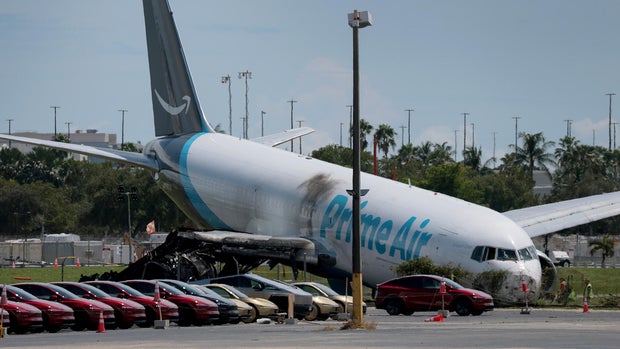
The crash of an Amazon cargo plane overshooting the runway at Miami International Airport resulted in the tragic loss of five lives. Witness Abraham Altamar described the scene as “surreal” and “scary.” He saw one of the pilots emerge from the cockpit, visibly distressed and trembling after the incident.
Altamar, who had been near the airport, was on a call with his wife when the shaken pilot approached him, needing to contact his own wife. “He was injured in his forehead and hand,” Altamar explained. “I offered to call 911, but he said they had already been contacted.” Altamar lent his phone so the pilot could reassure his wife and mother of his safety despite declaring, “My career is over.”
The Miami-Dade Sheriff’s Office, LinkedIn profiles, and FAA records identified the pilots as Joseph Carroll, 55, and Jaime Felipe Silva Molina, 37. Their respective roles as captain and first officer with carrier 21 Air were noted. Both pilots sustained injuries but have since been released, stated NTSB Chair Jennifer Homendy.
Prime Air Flight 7598 overran the runway on September 6, 2026, during landing. The NTSB investigation involved equipment collision, the crash into a cleaning crew van, further contact with a Toyota SUV, and a halt near parked Tesla robotaxis. The victims were occupants of the two impacted vehicles.
Recovered cellphone footage displays a crew member escaping the aircraft post-crash. Interviews with the flight crew remain pending. The aircraft’s black boxes containing crucial voice and data recordings are under NTSB analysis in Washington, D.C.
A full cooperative investigation is underway with Amazon and 21 Air. Homendy likened the crash site’s appearance to tire marks trailing off the pavement and extensive debris, labeling it “devastating.” The possibility of implementing an Engineered Materials Arresting System (EMAS) across airports is under consideration. EMAS aids aircraft deceleration via collapsible, lightweight material, particularly beneficial when full runway safety zones are absent.
At Miami International Airport, the runway overrun area meets the 1,000-foot safety standard. The discovery may hold implications for future airport safety standards.