
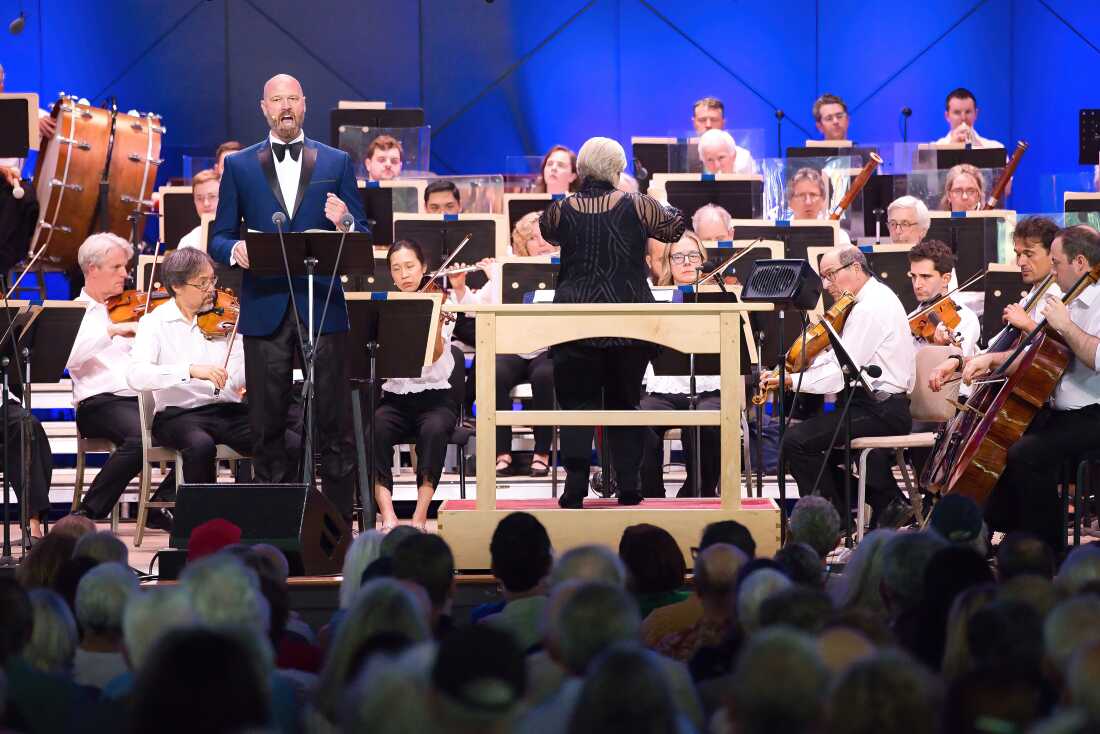
Baritone Zachary James and the Boston Symphony Orchestra, guided by conductor Karen Kamensek, performed Philip Glass’ Symphony No. 15 ‘Lincoln’ at Tanglewood in Lenox, Massachusetts, on July 5, 2026.
Initially, it seemed fitting for composer Philip Glass to unveil his latest symphony at the Kennedy Center during the country’s 250th anniversary celebrations. Glass’ work pays tribute to Abraham Lincoln, and he is an esteemed American composer, receiving the National Medal of Arts in 2015. However, the plans took a turn, leading to its debut with the Boston Symphony Orchestra (BSO).
Lincoln has been a recurring presence in Glass’ compositions—appearing in works like The Civil Wars and the opera Appomattox. Glass’ opera The Perfect American even features an animatronic Lincoln, similar to the one in Walt Disney World’s Hall of Presidents, alongside a machine duet with Walt Disney.
This time, Glass chose an exclusive focus on Lincoln, incorporating Lincoln’s own words. The symphony was originally set to premiere with the National Symphony Orchestra. Recent developments at the Kennedy Center, including the presence of President Trump as chairman since 2025, led Glass to view the arts complex as politicized. In January, he withdrew the symphony’s premiere, citing conflicting values with the leadership, saying on social media: Symphony No. 15 is a portrait of Abraham Lincoln, and the values of the Kennedy Center today are in direct conflict with the message of the Symphony.
The Boston Symphony Orchestra performed the symphony at Tanglewood, paired with a suite from John Williams’ music for Lincoln, the film by Steven Spielberg. Additionally, actor Alec Baldwin narrated Lincoln Portrait by Aaron Copland.
Philip Glass, now at 89 years old, has declined interviews. Conductor Kamensek, familiar with Glass’ work for 30 years, appreciates his dedication to Lincoln’s self-expression and the farsightedness of Lincoln’s words. Kamensek notes that the symphony showcases melodies but emphasizes Lincoln’s speeches, which remain contemporary and visionary.
In Glass’ program note, he mentions Lincoln’s ability to unify the nation during its divisions as a fitting subject for the country’s milestone birthday.
Baritone Zachary James embodies Lincoln in the performance, merging sung and spoken parts. James finds the portrayal uniquely challenging and speaks of the emotional freedom allowed by spoken word—contrasting it with singing, where tears and song cannot coexist.
Reflecting on Lincoln’s candid public expressions, James acknowledges Lincoln’s uniqueness as a man openly emotional in an era when such openness was rare.This is who he was. And he was incredibly open and vulnerable, speaking in a way that men did not speak in that time.
Conductor Kamensek describes the symphony’s unusual ending: not with grandeur, but with prolonged quiet chords. She interprets them as symbolic pillars, expressing society’s foundational morals and values. In rehearsals before the premiere, she instructed musicians to focus their sound, encouraging the audience to take interpretations from the symbolic columns.
Such messages resonate at any time but find particular relevance around Independence Day.
Audio recording of the concert courtesy of the BSO and GBH Music.