
The Red Cross has reported the deaths of three dedicated volunteers in the Democratic Republic of Congo. These individuals succumbed to Ebola, contracted while serving in March. The outbreak has affected DR Congo and neighboring Uganda, with the World Health Organization declaring it an international public health emergency.
The International Federation of Red Cross and Red Crescent Societies confirmed the volunteers were part of the DR Congo Red Cross based in Ituri, the outbreak’s epicenter. Their work involved managing dead bodies in Djugu territory without prior knowledge of the Ebola outbreak.
“Alikana Udumusi Augustin, Sezabo Katanabo, and Ajiko Chandiru Viviane likely contracted the Ebola virus on March 27. Their duties were unrelated to Ebola awareness at that time,” stated the IFRC.
The community was unaware of the outbreak during their intervention, marking them among the outbreak’s first known victims.
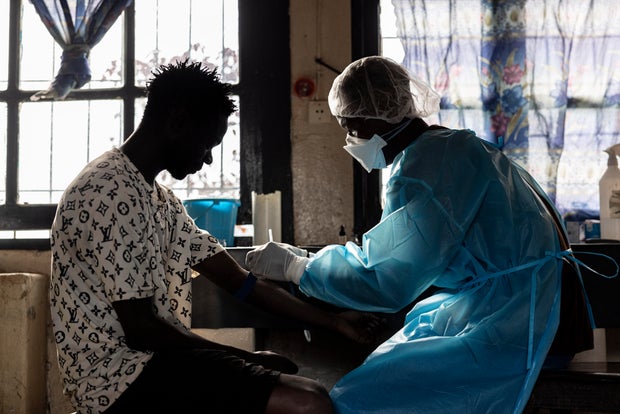
Photographic evidence from May 20, 2026, shows a patient at General Referral Hospital of Mongbwalu undergoing a blood test as part of the Ebola response efforts in Ituri province.
The IFRC confirmed one volunteer passed away on May 5, with the other two succumbing on May 15 and 16. They praised the volunteers’ bravery and humanity, exemplifying the dedication of Red Cross volunteers globally. The organization, with over 17 million volunteers across 191 countries, remains committed to supporting Ebola-affected communities and enhancing outbreak response efforts.
The Africa Centres for Disease Control and Prevention has expanded the high-risk country list. It now includes Angola, Burundi, Central African Republic, Ethiopia, Kenya, Rwanda, South Sudan, Tanzania, and Zambia.
Recent developments in Uganda revealed three new Ebola cases, increasing the country’s total confirmed cases to five. These include a Ugandan driver, a health worker, and a Congolese woman with mild symptoms. As of now, Congo has 82 confirmed cases and seven confirmed deaths. Suspected cases stand at nearly 750 with 177 suspected deaths.
Dr. Craig Spencer, an emergency physician and public health professor at Brown University, expressed concern for healthcare workers. Having survived Ebola after exposure in Guinea, Spencer highlighted the high contagion risk for those in close contact, especially around patients’ deaths.
Ebola, a lethal viral disease, spreads via direct contact with infected bodily fluids, causing severe symptoms and organ failure. The current strain, Bundibugyo virus, presents challenges due to the lack of an approved vaccine or treatments.
The WHO elevated Congo’s risk status to “very high” on Friday, while maintaining a high regional risk and a low global risk level.