
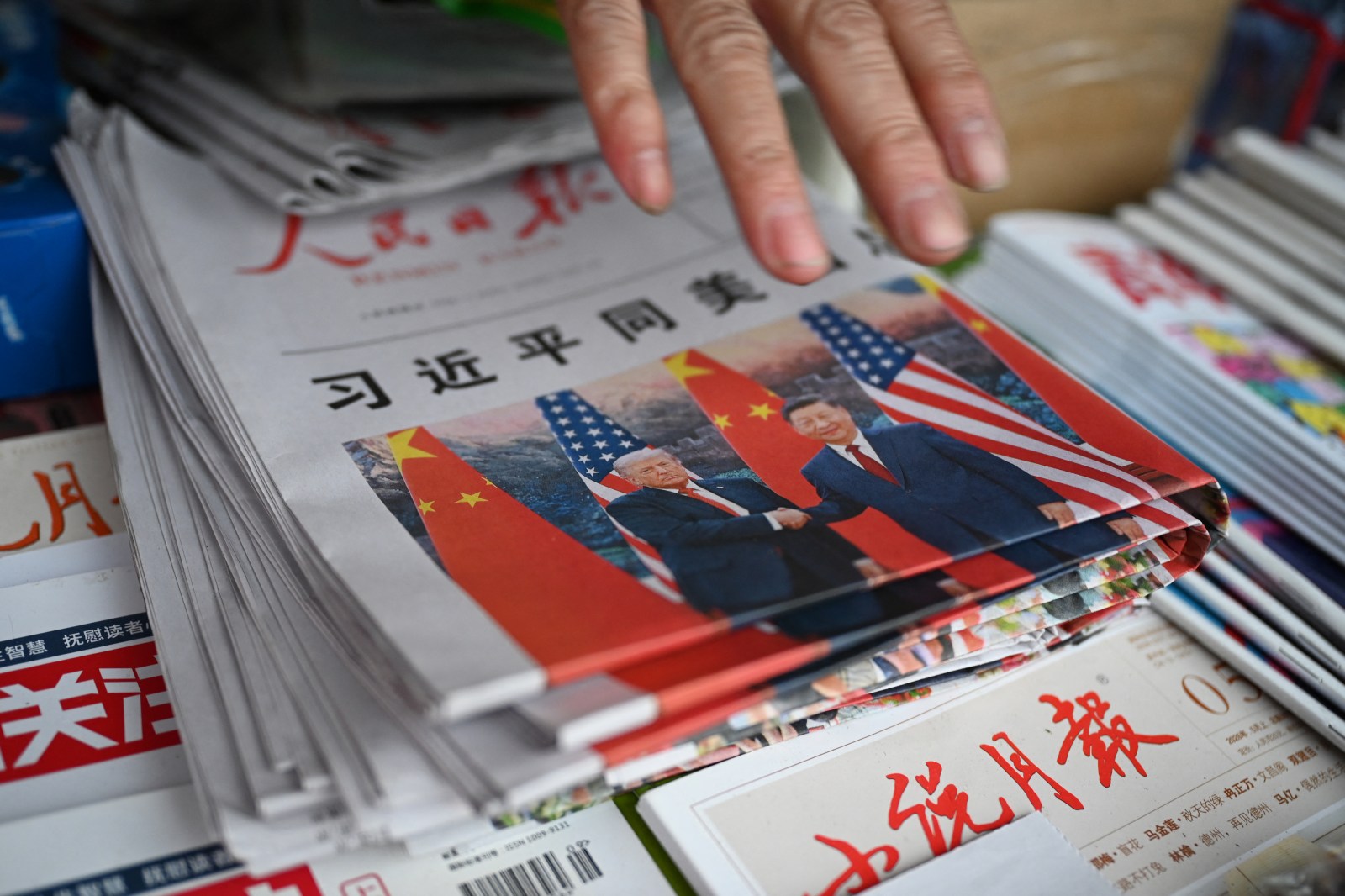
President Donald Trump announced his intention to speak with Taiwan’s President Lai Ching-te regarding an arms package that has been delayed after his recent trip to China. Engaging with Taiwan always prompts challenges in the U.S.-China relationship due to China’s claim over the island. However, when asked about a possible call, Trump stated, “I speak to everybody.”
He was questioned about whether he would contact Lai before deciding on a proposed $14 billion arms sale, which the State Department has held up for several months. Trump reassured reporters by saying, “We have that situation very well in hand. We had a great meeting with President Xi. It was amazing, actually, many of you were there. We’ll work on that, the Taiwan problem.”
Trump previously accepted a call from Taiwan President Tsai Ing-wen before taking office, breaking the precedent since the U.S. severed diplomatic ties with Taiwan in 1979. Known for engaging with numerous world leaders, Trump remains open to discussions.
Taiwan Foreign Ministry spokesperson Hsiao Kuang-wei informed Newsweek that President Lai emphasized ongoing communication channels with the U.S. and reiterated Taiwan’s commitment to peace and stability in the Taiwan Strait as vital for global security. “Our government maintains the status quo with neither arrogance nor subservience. Taiwan is a guardian of peace and stability in the Taiwan Strait,” Kuang-wei noted.
Why Taiwan Matters…
Taiwan, governed democratically, stands as one of America’s leading trading partners. It has emerged as the top producer of advanced computer chips globally, vital for smartphones, computers, fighter jets, and missiles. Despite this, Beijing claims the island and has persistently addressed tensions with the U.S. over arms supplies to Taipei. China’s president has warned of potential conflict due to diverging views on Taiwan.
U.S. Secretary of State Marco Rubio assured NBC News that America’s stand on Taiwan’s self-governance remains unchanged. He stated, “It was raised. They always raise it on their side. We always make clear our position and we move on to the other topics.” This issue consistently causes diplomatic clashes between the U.S. and China. In 2022, former House Speaker Nancy Pelosi’s visit to Taiwan heightened tensions, marking her as the highest-ranking U.S. official to visit in 25 years, and illustrating a broader mission against authoritarian regimes.
Taiwan Weapons Package: What To Know…
The $14 billion arms package under consideration between the U.S. and Taiwan includes HIMARS rocket systems, anti-tank missiles, loitering suicide drones, military software, and anti-armor missiles. This deal, announced in December 2025, follows Taiwan’s increasing military pressures from China seeking control over the island.
Following his China visit, Trump discussed the deal with China’s leader, emphasizing his desire to avoid another war. Huang from Taiwan suggested, according to Newsweek, that “China was ‘the disruptor of peace'” and that strengthening Taiwan’s defense is crucial. President Lai welcomes further discussion with Trump on maintaining regional stability.
A Chinese U.S. embassy spokesperson stressed the Taiwan issue’s significance in U.S.-China relations, urging the U.S. to abide by past agreements, including the August 17 Communiqué of 1982. They called on the U.S. to cease arms sales to Taiwan and avoid sending “wrong messages” to Taiwan separatists.
Trump might delay new weapons packages for Taiwan due to upcoming talks with President Xi in the U.S. and the Asia-Pacific Economic Cooperation summit in Shenzhen. Nonetheless, his comments indicated a desire for a timely agreement. A White House official confirmed that any decision would align with longstanding U.S. policy.