
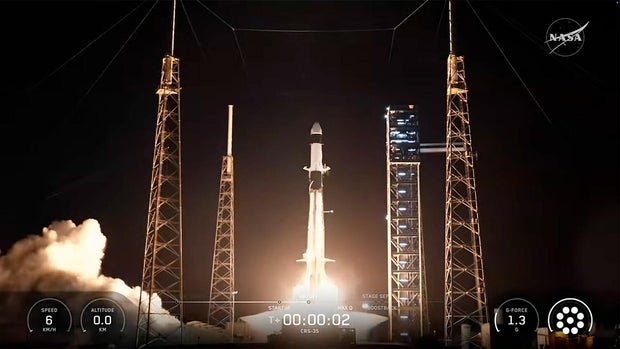
On Tuesday, a SpaceX Falcon 9 rocket successfully launched an unpiloted Dragon cargo ship into orbit. The spacecraft is set for a rendezvous with the International Space Station (ISS) early Thursday, carrying over 6,300 pounds of research materials, spare parts, and crew supplies.
Included in the cargo are two new roll-out solar array blankets. These represent the final sets in a significant power system upgrade to address age-related degradation of the station’s original eight solar wings. Since June 2021, six “IROSA” blankets have been installed during spacewalks. The seventh and eighth IROSA arrays aboard the Cargo Dragon will be added during spacewalks planned for later this month and early November.
The Falcon 9 rocket lifted off smoothly from pad 40 at the Cape Canaveral Space Force Station. Its nine first-stage engines powered up at 6:33 a.m. EDT, generating 1.7 million pounds of thrust. Two-and-a-half minutes after liftoff, the rocket’s first stage separated to return to its launch site, while the second stage continued its trajectory into orbit.
At the same time, spectators at the Kennedy Space Center were treated to a remarkable sight. The ISS passed 260 miles above them, creating a time-lapse view with the Falcon 9’s contrails and first-stage separation.
The Falcon 9’s first stage landed nearby its launch site at 6:41 a.m., with the second stage shutting down shortly after. The Cargo Dragon then detached to embark on its autonomous journey to the ISS, expected to dock at the station’s Harmony module around 11 a.m. Thursday.
The launch was visually striking as the Falcon 9’s second-stage exhaust plume widened and caught sunlight, creating the “jellyfish effect,” a phenomenon known among space enthusiasts.
The Cargo Dragon is stocked with over 6,300 pounds of cargo, including 844 pounds of crew supplies, 1,307 pounds of scientific equipment, 417 pounds of tools for spacewalks, and 880 pounds of hardware and computing supplies. Fresh food for the crew is also aboard, featuring oranges, apples, grapefruit, tomatoes, blueberries, baby carrots, and mini sweet peppers. Additional treats include a pizza kit, cookies, candy, and special holiday provisions.
The IROSA solar arrays weigh 2,635 pounds on Earth and are located in the Dragon’s unpressurized trunk section. Each solar blanket generates 20 kilowatts of electricity, revitalizing the station’s power levels.
According to Dana Weigel, director of low-Earth orbit operations at Johnson Space Center, “The new arrays are installed on top, over in front of the existing solar arrays.” She noted that older arrays continue generating electricity alongside the new. Weigel explained that the IROSA arrays are equipped with advanced solar cells, boosting energy efficiency and density, effectively enhancing power output compared to the original arrays when new.