
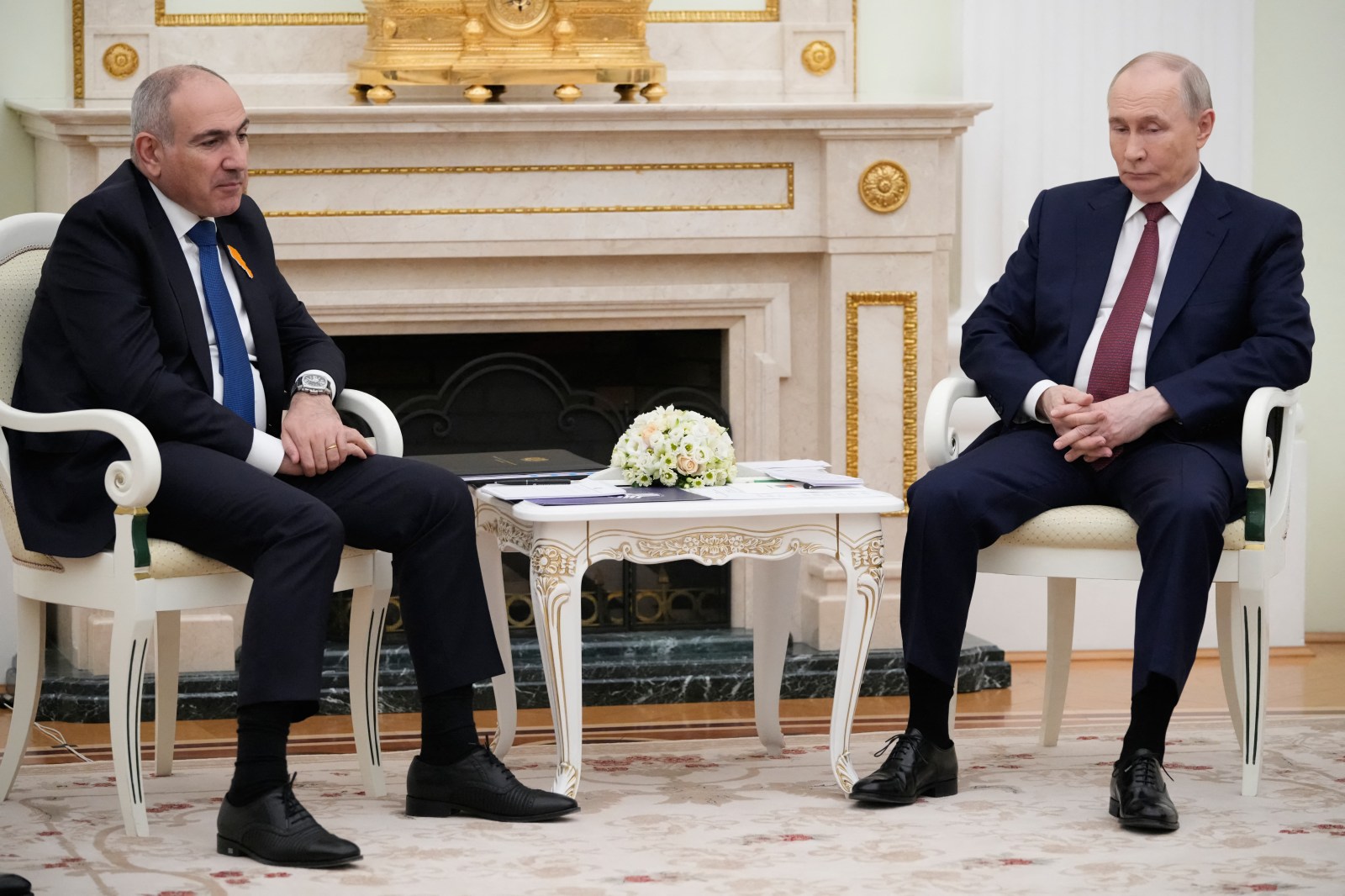
Armenia, a founding member of Russia’s post-Cold War alliance, the Collective Security Treaty Organization (CSTO), is moving forward with plans to exit the bloc. This decision challenges Moscow’s historical influence at the crossroads of Europe and Asia. On Monday, Armenian Prime Minister Nikol Pashinyan reaffirmed his decision to suspend cooperation with the CSTO, citing its failure to assist Armenia in conflicts with Azerbaijan. Pashinyan expressed openness to any decision by the six-nation coalition to expel Armenia, stating, “I will be very pleased if the organization decides to expel the Republic of Armenia from the Collective Security Treaty Organization. At least it will free us from the dilemma of not leaving.”
Kremlin spokesperson Dmitry Peskov responded by saying that if Armenia no longer finds value in the CSTO for securing regional safety, it is free to leave. Richard Giragosian, head of the Regional Studies Center in Yerevan, described Armenia’s stance as “rather belated,” criticizing the CSTO as an unreliable security provider amidst Azerbaijan’s attacks on Armenian territory. Despite diplomatic progress with Azerbaijan, the Russian-dominated CSTO is seen as ineffective for Armenia. Giragosian noted Armenia’s cautious approach to avoid provoking Russia, choosing to suspend contributions rather than exit entirely.
Historical Context of Armenia-Russia Relations
Russia has influenced Armenia since 1828, when much of modern Armenia became part of the Russian Empire. Armenia briefly gained independence in 1918 but joined the Soviet Union in 1920 alongside Azerbaijan and Georgia. After securing independence in 1991, Armenia retained military ties with Russia, joining the collective security treaty that became the CSTO. Conflicts with Azerbaijan over Nagorno-Karabakh intensified these ties.
Azerbaijan and Georgia initially joined the security treaty but left in 1999. Similarly, Uzbekistan joined in 2006 but exited in 2012. Tensions in Nagorno-Karabakh, including major conflicts in 2020, 2022, and 2023, tested Armenia’s reliance on Russia. Russia’s limited intervention on Armenia’s behalf sparked doubts about Moscow’s commitment, especially after its 2022 invasion of Ukraine.
Prime Minister Pashinyan acknowledged the historic role of Russian protection but noted Russia’s security limitations due to its own challenges. The current CSTO members include Armenia, Belarus, Kazakhstan, Kyrgyzstan, Russia, and Tajikistan. Among them, only Belarus has supported Russia’s actions in Ukraine.
Rising U.S. Influence
As Russia struggles to retain Armenia’s confidence, the U.S. has sought to strengthen ties. Former President Joe Biden began diplomatic efforts with Armenia, leading to a strategic partnership before Donald Trump took office for a second term. In 2025, Trump hosted Armenian and Azerbaijani leaders to agree on a peace initiative, the “Trump Route for International Peace and Prosperity” (TRIPP), aimed at linking Azerbaijan to its exclave via Armenian territory.
Pashinyan has announced plans to pursue closer ties with the European Union and maintain relations with Russia’s economic bloc, the Eurasian Economic Union. This approach signifies Armenia’s effort to balance its Western engagements while maintaining connections with Russia.
Navigating Geopolitical Challenges
Armenia continues to adjust its geopolitical strategy between deepening Western ties and relying on Russian support. Mher Sahakyan of the China-Eurasia Council for Political and Strategic Research noted that Armenia avoids directly antagonizing Russia by only freezing CSTO involvement. At the same time, the country seeks to maximize security partnerships while maintaining flexibility.
Sahakyan believes the U.S.-Armenia strategic partnership is promising for economic and technological development. However, he cautions that the South Caucasus remains a secondary priority for the U.S., which may limit Washington’s long-term commitment to regional dynamics.