
El Niño and Coastal Flooding
A rare convergence involving a powerful El Niño, super king tides, and sea level rise due to climate change threatens California with record coastal flooding this winter. Officials have already noticed higher-than-normal tides, impacting beaches, parking lots, bathrooms, and resurfacing long-hidden coastal infrastructure. These challenges will likely intensify once El Niño increases in strength.
Jonathan Warrick, a research geologist at the U.S. Geological Survey, explains that El Niño, often viewed as a Southern California rainmaker, also amplifies sea levels. “During El Niños, waters offshore California warm and rise up, sometimes reaching a foot or more above average,” he noted. Although this rise may appear minor, it significantly endangers low-lying homes and coastal infrastructure.
Historical Patterns and Sea Level Rise
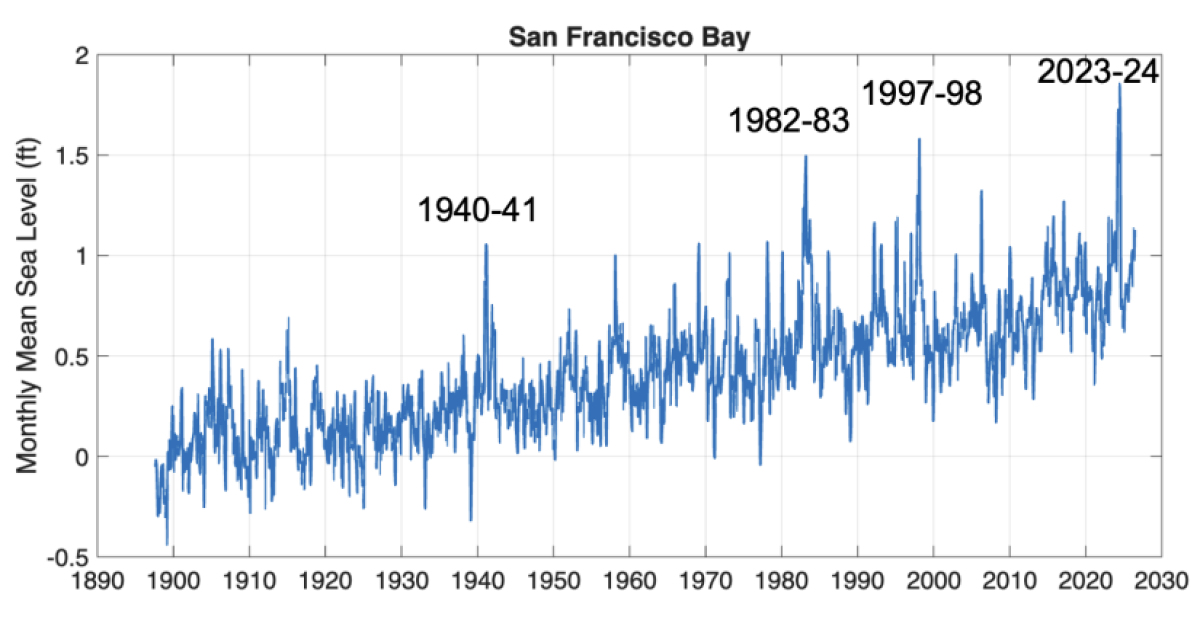
Over the past century, experts have linked the average sea level rise in San Francisco Bay to human-induced climate change, noting an increase of about one foot. Daniel Swain, a climate scientist at UC, highlights the potential for record-high sea levels in California this winter, posing severe risks.
This pattern isn’t new; previous “very strong” El Niños in 1982-83 and 1997-98, along with the “strong” El Niño in 2023-24, resulted in record monthly average sea levels in San Francisco Bay.
Warrick emphasizes the potential issues posed by higher seas, including coastal erosion and wave impacts on cliffs and nearby structures. Landslides and flooding become prominent concerns when rain attempts to drain but faces high ocean levels.
El Niño and Rising Sea Levels
Characterized by warmer ocean waters in the central and eastern tropical Pacific Ocean, El Niño is already raising sea levels off Latin America’s coast. As the water warms, it expands; in June, NASA showcased sea levels half a foot higher than average off Peru, Ecuador, Colombia, and Panama.
Swain observed similar water level increases along the South American Pacific coast, extending through Central America, the west coast of Mexico, and into the Gulf of California.
Impacts on California’s Coast
For months, California’s coast experienced a marine heat wave independent of El Niño. According to NOAA’s marine heat wave tracker, Southern California’s recent heating could be due to El Niño.
Recent tide observations reported peaks of 6 inches above forecasts in San Diego, Los Angeles, and Mendocino County’s Arena Cove; 5 inches higher in San Francisco and Santa Monica; and 4 inches more in Monterey. Humboldt County’s North Spit experienced tides 9 inches above forecasted levels. “We’re observing tides that exceed predictions by 4 to 6 inches, which is considerable,” stated Jeremy Smith, a coastal engineer at the California Coastal Commission.
King Tides and Lunar Cycles
California faces exceptionally high king tides coinciding with El Niño’s full influence. Annually, peak high tides occur around the summer and winter solstices, but long-term lunar cycles, such as the 18.6-year lunar node and the 4.4-year lunar perigee tidal cycles, also contribute to tidal forces. According to Reinhard Flick of UC San Diego, “These cycles are intensified this year, meaning strong king tides will align with higher sea levels from El Niño.”
The 4.4-year cycle coincided with coastal flooding during the 1982-83 El Niño, as noted in a 1985 Journal of Physical Oceanography study. High tides are expected around Thanksgiving, Christmas Eve, and January 22, potentially leading to coastal erosion and damage, Flick warns.
Potential Flooding in Low-lying Areas
In areas like San Diego’s Mission Beach and Surfside in Seal Beach, rising tides pose flood risks. “Our low-lying beachfront developments face overtopping waves and potential flooding if storm drains are overwhelmed,” noted Smith.
Furthermore, the El Niño climate pattern may lead to above-average precipitation in Southern California. The winter of 1982-83 had record rainfall, marking the wettest season in recorded history for California. The National Weather Service’s Climate Prediction Center anticipates an above-average precipitation winter.
Forecasters predict a wet winter for California and the southern U.S. The Climate Prediction Center recently stated that California will likely see above-average precipitation in January, February, and March.