
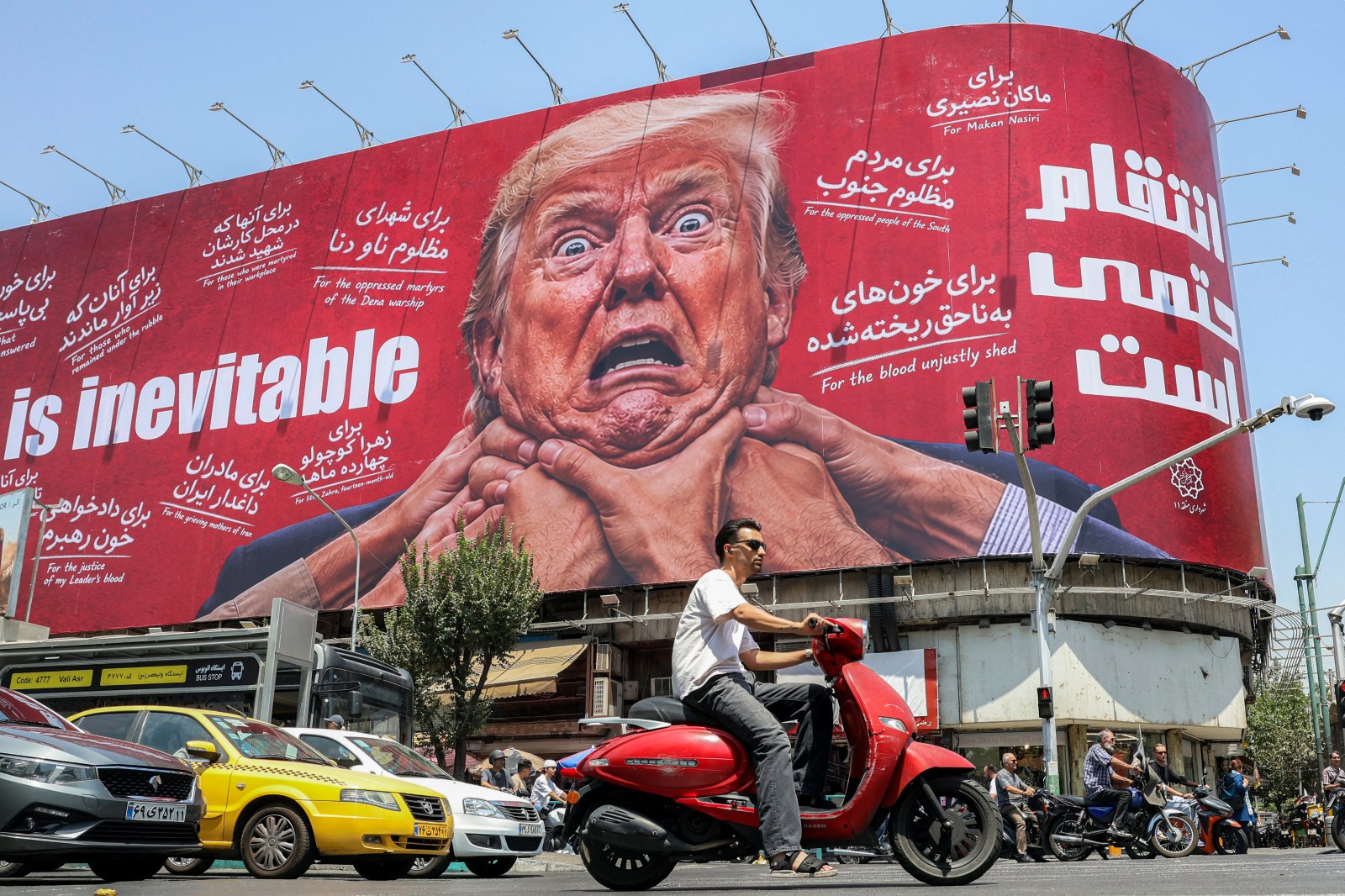
President Donald Trump has threatened Iran with unprecedented economic sanctions, claiming ‘the most crushing economic operation ever taken against any country.’ This threat adds to a series of grand declarations aimed at pressuring Iran into compliance.
Last month, Trump mentioned he had intended to launch the most significant attack on Iran since World War II, reflecting on a conflict that concluded with the use of atomic bombs. In April, during a pause in the U.S.-Israeli conflict with Iran, he dramatically stated that ‘a whole civilization will die tonight.’ Such hyperbolic threats have not been executed; instead, they were shelved in favor of diplomatic strategies.
Recently, Trump announced that negotiations with Iran were halting, contradicting earlier suggestions by his adviser, Jared Kushner. Sources revealed that positive discussions had occurred, yet Trump instructed his team to pause engagements until Iran showed willingness to negotiate.
Despite these dynamics, Tehran seems relatively unmoved by Trump’s aggressive rhetoric. Calls for escalation are growing within Iran’s leadership.
Mehran Kamrava, a political expert, highlighted that these threats are largely dismissed by Iran. Kamrava noted the perception within Iranian leadership circles that a ‘neither peace nor war’ state is unsustainable long-term, making military escalation increasingly appealing.
Unpredictability vs. Unreliability
Trump’s approach, with its unpredictable threats and policy shifts, has been linked to the ‘madman theory’ associated with Richard Nixon. This concept involves keeping adversaries uncertain about the president’s real intentions, affecting not only Iran, but also countries like China and Russia.
Trump’s military actions, such as interventions in Venezuela and strikes against Iran’s nuclear facilities, suggest a willingness to act. Notably, the killing of Iranian Major General Qassem Soleimani demonstrated resolve.
The conflict escalated with a joint U.S.-Israeli operation in February, during which Iran’s Supreme Leader Ayatollah Ali Khamenei was killed. Although nearly six months have passed, Iran has displayed resilience by exerting control over the Strait of Hormuz and launching attacks on regional adversaries.
Iran now focuses on strengthening military stockpiles and alliances, including ties with Hezbollah and Houthi forces, to enhance its strategic position against U.S. interests. Iranian Foreign Minister Abbas Araghchi dismissed Trump’s threats as a diversion from America’s domestic issues, while Brigadier General Hossein Mohebi emphasized Iran’s strategic weapon upgrades.
Strategic Calculations
Mohsen Milani, an expert from the University of South Florida, mentioned that both Tehran and Washington use ambiguity to their advantage. While Trump employs unpredictability to maintain leverage, the lack of clear U.S. strategy has hindered political outcomes. Tehran perceives its strategic gains from the conflict as leveraging control over Hormuz to extract concessions from the U.S.
Milani’s perspective highlights the duality of unpredictability offering leverage and unreliability damaging credibility. Tehran, anticipating further conflict, evaluates U.S. actions skeptically.
Economic Pressures and Resilience
Trump’s declarations might be more than simply verbal posturing. The UAE, a significant trading partner with Iran, announced halting all trade and financial transactions as a response to missile launches allegedly targeting its territory. However, Iran denied responsibility, attributing the act to a ‘false flag operation’ by its adversaries.
Milani stated that both the U.S. and Iran believe in their economic endurance. Trump’s aggressive stance seeks to suffocate Iran economically, but years of sanctions have not yielded strategic victories for the U.S. Jon Alterman, a former U.S. State Department official, noted Iran’s belief in its capacity to outlast both U.S. and regional pressures.
Iran perceives itself more resilient under attack from major powers. Despite internal challenges, its leadership sees advantages in the conflict, such as witnessing regional states struggling economically and a U.S. administration under election pressure.
Alterman emphasized that Iran regards this period as crucial, requiring patience and determination to achieve long-term security and economic recovery. While diplomatic discourse may occur, Iran anticipates protracted negotiations rather than swift resolutions.