
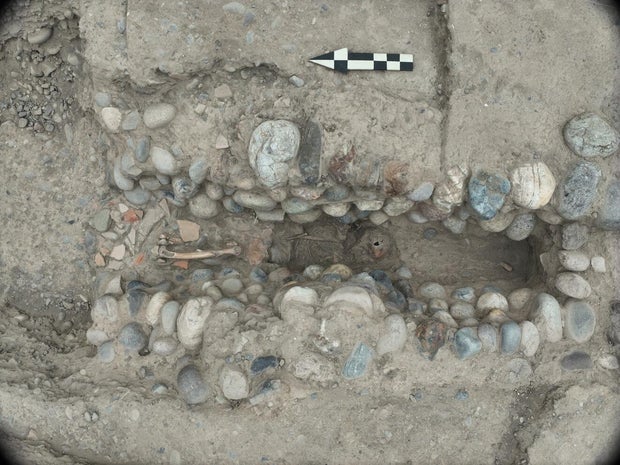
Archaeologists have revealed the discovery of skeletal remains believed to be an adult offer near Huaca Pucllana, an ancient adobe pyramid in Lima, Peru. Officials suspect the remains belong to a man sacrificed during a ritual closing of a canal linked to a ceremonial pool.
The remains are estimated to be around 1,400 years old, dating back to approximately A.D. 650, according to Peru’s culture ministry, which released several images of the excavation.
“The bones will help researchers understand the rituals of the Lima culture,” archaeologist Gladys Paz stated. “This will aid in reconstructing ceremonies performed over centuries ago.”
The body was positioned on its left side, with its skull oriented towards both the pyramid and the Pacific Ocean. A significant feature of this find is the architecture of the ceremonial well, made from river stones, contrasting with other structures at Huaca Pucllana, which typically use small mud bricks.
The Lima culture thrived from the first through the seventh centuries along Peru’s arid central coast, long before the emergence of the Inca Empire. Huaca Pucllana served as a major ceremonial and administrative hub for this culture, which vanished centuries before Spanish conquistadors established Lima in 1535.
Today, Huaca Pucllana is nestled among parks, leafy streets, and upscale districts like Miraflores and San Isidro and offers tourists Peruvian culinary delights, including ceviche, stir-fried beef, and roasted alpaca.
According to Peru’s government, over 400 archaeological sites exist within metropolitan Lima. Pieter Van Dalen, a National University of San Marcos archaeology professor not involved in the discovery, noted that finding tombs and burial items along Peru’s coast is common.
In July 2025, utility workers expanding a gas network in Lima uncovered two pre-Incan tombs over 1,000 years old. The previous month, a 1,000-year-old child’s mummy was discovered while installing pipes. Earlier in April 2025, archaeologists found 5,000-year-old remains of a noblewoman at the sacred Peruvian city of Caral.