
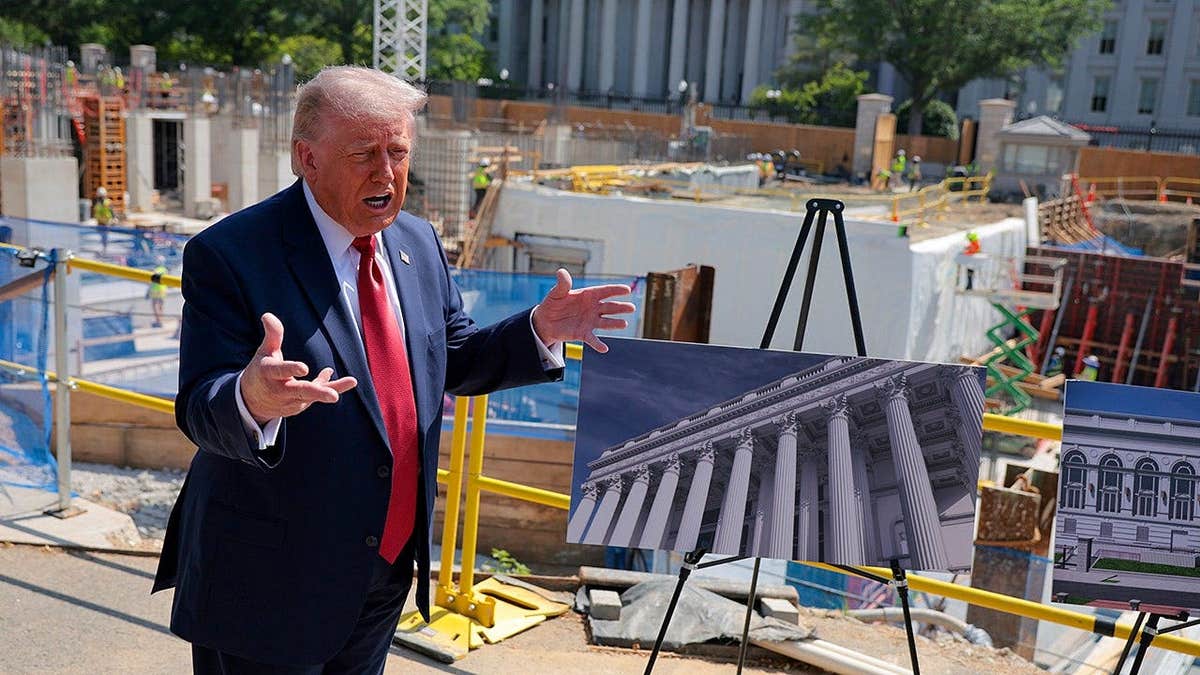
President Donald Trump might succeed in his legal battle over a White House ballroom through the Supreme Court. Experts suggest that the court could dismiss the case without addressing constitutional questions.
Trump, after a decision by the D.C. Circuit Court, announced plans to appeal to the Supreme Court. The lower court upheld a decision stopping above-ground construction unless approved by Congress. The court’s 2-1 majority argued that the project required Congressional authorization.
Trump cited a dissent by Judge Neomi Rao, a Trump appointee. Rao contended that the plaintiffs, the National Trust for Historic Preservation, lacked standing. The Trust claimed legal standing through Alison Hoagland, a member living nearby who frequently visits President’s Park. Hoagland argued the ballroom would diminish her enjoyment through its scale and design.
Trump argued the ruling risked future presidents’ safety and vowed to appeal.
The National Trust’s case is tied to Alison Hoagland. Hoagland, residing near the White House, stated the ballroom would negatively affect her monthly visits due to its size.
Rao countered, saying aesthetic displeasure was unjustly prioritized over the government’s security interests. Former Justice Department attorney Abhishek Kambli agreed, suggesting the National Trust would struggle with the standing issue at the Supreme Court.
Kambli noted that although Congress created the National Trust, it still needed to prove the lawsuit aligned with its interests. He explained the challenge of proving aesthetic injury, stating regular use or intended use of the space is typically required for standing.
A similar case arose in July when Judge Amit Mehta dismissed a lawsuit against the America 250 UFC event at the White House. The plaintiffs failed to demonstrate aesthetic harm needed for standing.
Hans von Spakovsky, a senior legal fellow at Advancing American Freedom, predicted Trump would succeed on appeal. He emphasized the need for concrete and actual injury to bring a lawsuit, dismissing the idea of aesthetic injury from a passerby as insufficient.
If the Supreme Court addresses the case, it might do so without settling the administration’s authority to construct the ballroom.
The court might dismiss the case over the plaintiffs’ lack of standing, von Spakovsky suggested, noting Congress is unlikely to step in due to political divides.
The National Trust argued that Congress must approve new construction on federal property in Washington, D.C. Meanwhile, the administration claimed laws grant the president authority for alterations and improvements, including at the White House.
Abhishek aligned with Rao’s interpretation of “alteration” and “improvement” in real-property terms. He compared an extension to a house to improvements, suggesting it’s not a new construction but a modification.