
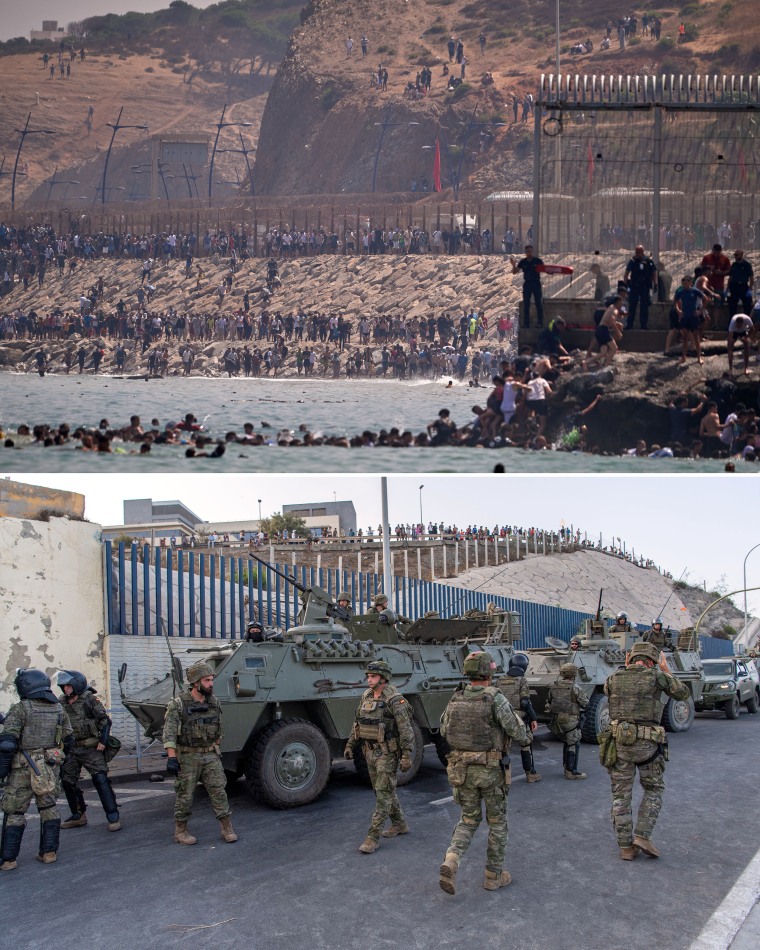
On July 31, 2026, the Associated Press reported a tragic incident involving the death of at least 18 migrants attempting to enter the Spanish territory of Ceuta. Thousands of individuals breached the border with Morocco, leading to a dire humanitarian crisis in the area.
The crisis reached a critical point on Thursday night. Spanish state broadcaster RTVE shared footage showing burned vehicles on the Moroccan side, indicating confrontations. Rachid Sbihi, a leader of a local workers association for Civil Guard officers, described the scenario as chaotic, with thousands, including unaccompanied children, living on streets and in parks.
“People continue to enter. Reinforcements help with injuries and humanitarian aid,” Sbihi noted, highlighting the disorder. Spanish soldiers were dispatched to Ceuta to manage the situation.
Spanish Prime Minister Pedro Sánchez and Interior Minister Fernando Grande-Marlaska are set to visit Ceuta. The Interior Ministry estimates around 49,000 migrants have entered the exclave in the past 24 hours. The fatalities included drownings and a deadly stampede at Tarajal beach.
Video footage revealed large groups, largely Moroccans, traversing breakwaters toward roads with families and children present. Some shouted “Viva España!” as they moved. While many sought to enter Ceuta, others attempted to return to Morocco.
The Moroccan government has not publicly commented, and its Interior Ministry did not respond to inquiries. It’s unclear what initiated such a massive crossing.
Spain serves as a pivotal entry point for migrants seeking economic prospects or fleeing violence. To reach Ceuta, migrants often swim from Fnideq or Belyounech, covering several miles.
The escalation followed a surge in attempts to swim to the exclave on Wednesday. Italy’s Premier Giorgia Meloni responded by threatening to suspend the Schengen Agreement to protect Italian borders, despite not sharing a border with Spain.
Ceuta’s increased migration is linked to a Spanish Supreme Court decision that prohibited the immediate return of sea-arriving migrants without due process. However, some activists doubt the ruling’s impact, stating that few migrants would be aware of it.
Juan Jesús Vivas, Ceuta’s regional head, called for a state of emergency, citing overwhelmed reception centers and security risks. Authorities reported migrants sleeping outdoors and estimated thousands more arrivals.
Spain’s Interior Ministry, which monitors migration, did not verify the number of recent arrivals in Ceuta but mentioned an upcoming migration report on August 3. The ministry noted that national emergency laws don’t classify migration flows as a security threat but assured coordinated efforts to handle the situation efficiently.
Ceuta, a historical isthmus under Spanish control since 1580, hosts a diverse populace of Christians, Muslims, Spaniards, and Moroccans, living in relative peace. The region remains a critical point for migrants seeking to improve their lives in Europe.