
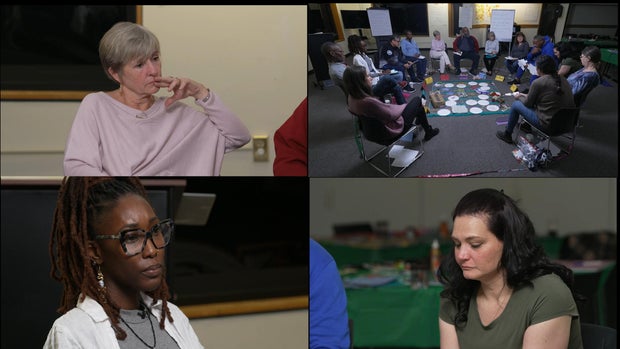
This week on 60 Minutes, correspondent Lesley Stahl and her team delved into the impactful work of Healing Justice. This nonprofit organizes three-day retreats that aid survivors of crimes like sexual assault, those wrongfully convicted, and their families. These events focus on healing the deep wounds caused by miscarriages of justice.
The retreats feature writing exercises, group sessions, and art therapy. Participants openly discuss their pain and loss and gain a deeper understanding of their emotions. Stahl observed that while a single weekend might not result in complete transformation, it does initiate change. During their attendance, the team witnessed participants speaking candidly about their experiences.
With participants’ consent, 60 Minutes filmed these emotional journeys. Stahl and producer Shari Finkelstein shared their insights on the program’s founder, Jennifer Thompson, and their distinct approach to producing the story.
The Story of Healing Justice’s Founder
Jennifer Thompson, Healing Justice’s founder, survived a rape and was part of a wrongful conviction case. In 2009, Stahl and Finkelstein reported on Thompson’s experience and the flaws of eyewitness identification for a segment titled “Eyewitness.”
In 1984, as a 22-year-old college student, Thompson endured a brutal assault. During the attack, she carefully noted details of her assailant. Days later, police showed her a photo lineup, where she identified Ronald Cotton as her attacker. Cotton faced a physical lineup and was identified by Thompson again.
Despite her conviction, it turned out Cotton was innocent. DNA evidence exonerated him after 11 years in prison and revealed Bobby Poole as the true perpetrator. The realization deeply affected Thompson.
The Perils of Eyewitness Identification
Thompson’s misidentification wasn’t isolated. Finkelstein explained that victims often choose the person who resembles the perpetrator if they are absent from lineups— a phenomenon Stahl personally experienced in a simulated crime scene.
Repeatedly seeing a wrongly identified person reinforces the belief in their guilt, creating a lasting impression.
Filming “Healing Justice”
Finkelstein majored in capturing the essence of the Healing Justice program. With consent, Stahl conducted on-camera interviews with nine participants before and after the retreat. Each pair, comprised of a victim and wrongfully accused individual, underwent filming. Cameras captured every group session and activity.
60 Minutes photographers arranged four cameras, including one on a quiet track, to record interactions during group sessions. Editor Dan Glucksman organized footage into a four-camera grid, enabling the team to observe reactions as they unfolded. They noted moments of empathy and transformation among participants.
Emotional Transformations
Loretta Zilinger White, a victim involved in a wrongful conviction case, shared her emotional state after the retreat, reflecting a significant change. Despite knowing the real culprit was never caught, her pain visibly lessened.
Another participant, Raymond Towler, spent 29 years wrongfully imprisoned. The prospect of some people still doubting his innocence left a lingering fear.
Moments of genuine connection unfolded, captured by photographer Tom Fahey. An intense conversation between Zilinger White and Towler occurred, with their consent to film.
As the retreat concluded, Zilinger White appeared transformed, her pain alleviated. Stahl witnessed her transition from despair to newfound joy.
Finkelstein noted that, while the retreat offered significant progress, healing remains ongoing. Thompson acknowledged this, stating she will “always be healing,” a sentiment reverberating among participants, marking an important first step on their journey.