
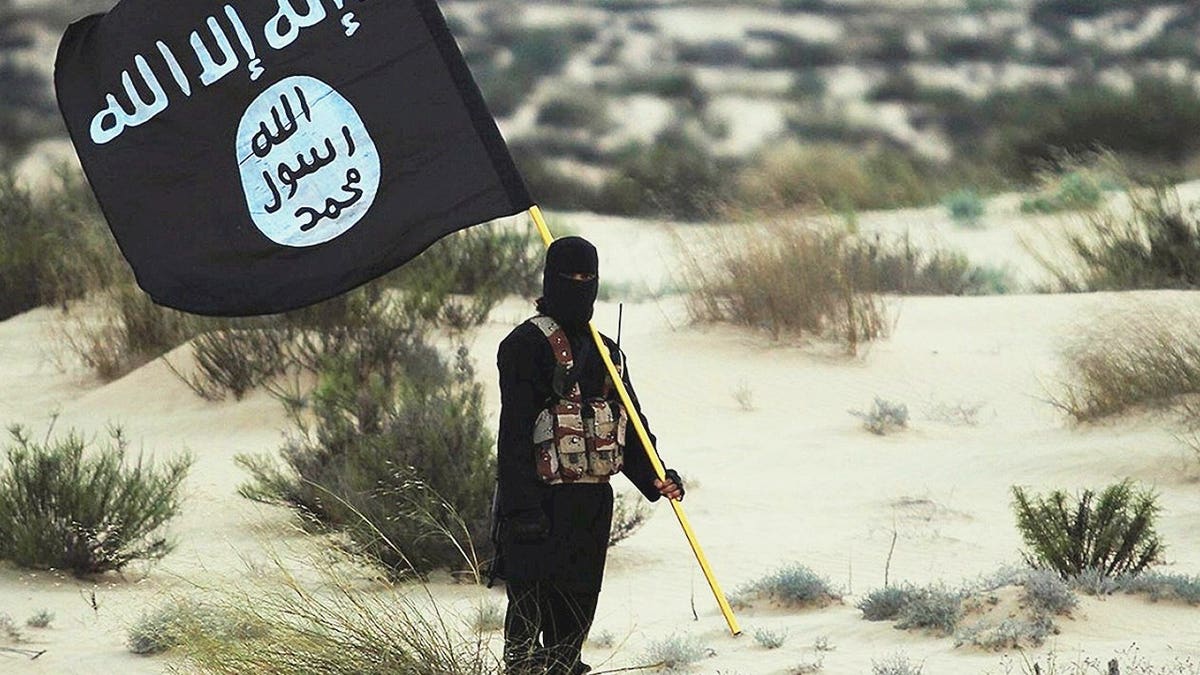
The Islamic State is furtively rebuilding as the United States prepares to finish its withdrawal from Iraq, raising concerns about exploiting a security void, a regional security specialist indicated on Sunday.
With U.S. forces set to exit by September 30, Baghdad’s efforts to curb Iran-backed militias might thrust Iraq into its most perilous phase since ISIS’s takeover of Mosul in 2014, according to counterterrorism specialist Dr. Omar Mohammed.
Mohammed, an author and researcher with the George Washington University Program on Extremism, remarked to Fox News Digital, “ISIS is actively lying in wait in the gaps, as it has historically.”
According to regional analysts, the Islamic State is quietly reassembling as the United States finalizes its withdrawal from Iraq.
“The question is not whether U.S. forces leave Iraq in September; that timetable is fixed. The question is what departs with them,” Mohammed stated. He explained that militias cite the ISIS menace to maintain their armaments while ISIS capitalizes on grievances generated by the militias.
Mohammed noted, “This is precisely the dynamic that eroded Mosul prior to 2014, as the city was ensnared between a sectarian security apparatus and the insurgency it fueled.”
After years of planning, ISIS captured Mosul, roughly 250 miles north of Baghdad, over a decade ago. Iraqi security forces disbanded and vacated the city as the group constructed clandestine networks via assassinations, extortion, intimidation, and infiltration, paving the way for their offensive.
ISIS acquired U.S.-manufactured weaponry and amassed hundreds of millions of dollars before leader Abu Bakr al-Baghdadi proclaimed the group’s self-declared caliphate.
During this period, Mohammed unveiled “Mosul Eye,” a blog that clandestinely documented life under ISIS rule, disclosing its operations and supplying intelligence to U.S. forces.
The Trump administration cautioned Iraq about Iran-connected terror proxies as the U.S. reportedly obstructed cash transactions.
U.S. Central Command (CENTCOM) affirmed its continued effort to dismantle ISIS networks and thwart the terror group’s resurgence.
Iraqi forces, supported by the U.S.-led coalition, regained control of Mosul in July 2017. When the U.S. combat mission concluded in 2021, ISIS persisted in parts of Iraq and Syria.
Mohammed disclosed that according to Iraqi intelligence assessments, the number of ISIS fighters in neighboring Syria surged from approximately 2,000 to nearly 10,000 following the downfall of Bashar Assad’s government in 2024.
He highlighted the Popular Mobilization Forces, or PMF, an integrative organization within Iraq’s security forces, was never dissolved post-ISIS’s territorial defeat.
Mohammed estimated the PMF harbors about 238,000 members, receives billions in government funding, and comprises factions closely linked to Iran that operate beyond Iraqi government regulation.
With the U.S. forces vacating by September 30 and Baghdad attempting to bring Iran-backed militias, such as Kataib Hezbollah and Asaib Ahl al-Haq, under full state control, Iraq confronts a precarious period akin to that preceding ISIS’s capture of Mosul in 2014.
“September 30 is not one deadline; it is two,” Mohammed expressed, referring to both the withdrawal of U.S. troops and the domestic disarmament initiative.
He elucidated the intertwined relationship between militias and ISIS, where each validates the other’s existence. Both factions flourish in unstable territorial zones the central state struggles to secure.
This withdrawal aligns with a 2024 U.S.-Iraq accord, which envisioned concluding the mission in Iraq by 2025 while preserving support for anti-ISIS operations in Syria through September 2026.
Mohammed cautioned against repeating earlier complacency, recounting that “Mosul did not fall in 2014 because ISIS was robust. It fell due to the withdrawal of monitoring systems capable of detecting its potency—presence, attention, and transparent ground-level reporting.”
Following Iraqi Prime Minister Ali al-Zaidi’s White House visit on July 14, where the departure of remaining U.S. troops from Iraq was announced, Tehran responded critically.
According to Iran International, Ali Akbar Velayati, an adviser to Iran’s Supreme Leader Mojtaba Khamenei, described al-Zaidi’s visit as “regrettable,” expressing that it tarnished Iraq’s dignity.
Mohammed asserted Iran’s sway within Iraq is vital to Tehran post-U.S. strikes that diminished parts of its proxy network.
“Iran’s strategic calculation holds greater significance now than at any time in the last decade because Iraq represents practically what remains for Iran,” Mohammed stated. “Thus, the regime’s genuine concern is not resurgence but irrelevance.”
Tehran is apprehensive of an Iraq where the government successfully disarms the militias, U.S. forces exit on Baghdad’s terms instead of Iran’s, and no prevailing security crisis exists to rationalize militias retaining arms independent of full state control.
“What transpires across the broader region after September will not be dictated by expressed intentions or diplomatic pledges,” Mohammed remarked.
Concluding with a warning, Mohammed stated, “I have witnessed the cost to a city when judgment errs. Whether ISIS amasses enough strength to alarm Iran, or retains just enough to benefit it, remains a pivotal question post-withdrawal.”