
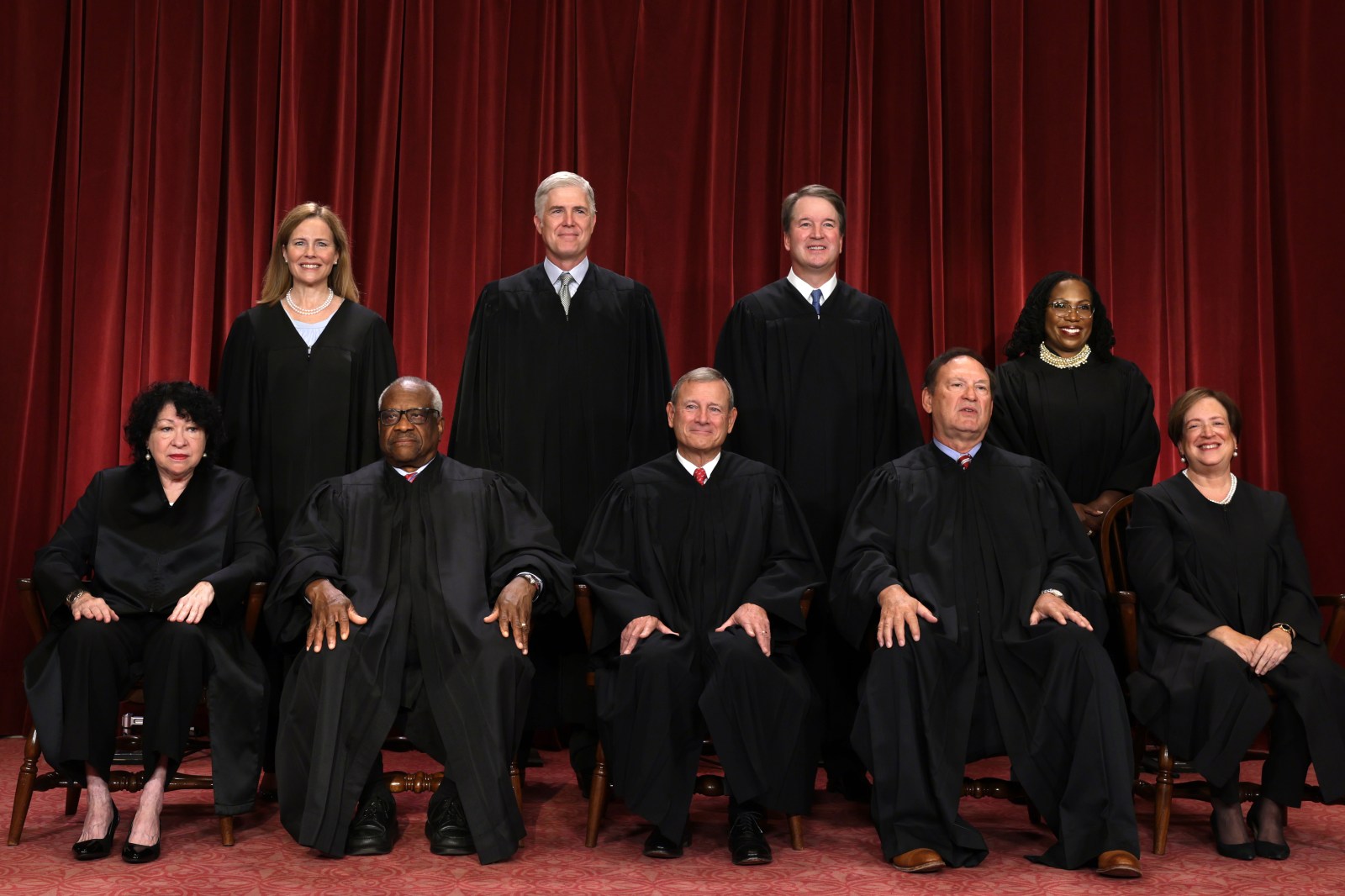
A recent national poll reveals a negative shift in the American public’s perception of several conservative Supreme Court justices. Conducted by YouGov/The Economist, the survey indicates a decline in net favorability ratings for Justices Clarence Thomas, Amy Coney Barrett, and Brett Kavanaugh over the past year. This change reflects a broader shift in Americans’ opinions about the court.
Justice Amy Coney Barrett experienced the largest drop in favorability, with an increase in “very unfavorable” ratings. Justices Thomas and Kavanaugh also saw decreases, with Kavanaugh’s net approval decreasing by 2 percentage points year-over-year, aligned with Chief Justice John Roberts. The survey highlights a general decline in the Supreme Court’s approval ratings, coinciding with growing skepticism towards the conservative justices.
Poll Insights
The poll, released on Tuesday, shows that the Supreme Court’s approval rating stands at 36 percent, with disapproval at 50 percent. Additionally, 9 percent of respondents view the court as “too liberal,” while 44 percent see it as “too conservative.” This data follows significant court decisions related to birthright citizenship and presidential power.
When asked about the impact of the Supreme Court’s rulings on presidential power, 45 percent of respondents believe the court has given the president too much power. Twenty-nine percent think the balance of power is right, while 9 percent say it is too little. The survey notes that 17 percent were unsure. The poll included 1,603 U.S. adults and has a margin of error of 3.3 percent.
Justice Favorability Breakdown
Chief Justice John Roberts, appointed by former President George W. Bush, has a favorability rating of 25 percent against a 36 percent unfavorable rating. His net approval stands at -11 percent, dropping from -9 percent last year. Brett Kavanaugh’s favorability is 27 percent with an unfavorable rating of 37 percent, marking a net approval of -10 percent, down from -8 percent last year.
Justice Neil Gorsuch, another Trump appointee, holds a 23 percent favorability rating against 30 percent unfavorable, with a net favorability of -7 percent improving slightly from last year’s -8 percent. Meanwhile, Justice Elena Kagan, appointed by former President Barack Obama, has a 30 percent favorability rating, leading to a net favorability of 6 percent, significantly improved from last year’s -3 percent.
Justice Sonia Sotomayor, also appointed by Obama, shows a 37 percent favorability against 26 percent unfavorable, resulting in a net favorability of 11 percent, an increase from 4 percent last year. Justice Samuel Alito holds a 25 percent favorability rating with 32 percent unfavorable, resulting in a -7 percent net favorability, slightly worse compared to last year’s -6 percent.
Justice Amy Coney Barrett’s favorability dropped to 23 percent against 38 percent unfavorable, decreasing her net favorability to -15 percent, down from -9 percent last year. Justice Clarence Thomas holds a 29 percent favorability against 41 percent disapproval, showing a -12 percent net approval compared to -9 percent last year.
Justice Ketanji Brown Jackson, appointed by President Joe Biden, has a 34 percent favorability against 26 percent unfavorable, yielding a net favorability of 8 percent, up from 2 percent last year. The previous year’s poll, conducted with 1,043 U.S. adults, had a margin of error of 4.3 percent.
Analysis of Barrett’s Ratings
Former Palm Beach County State Attorney Dave Aronberg noted, “The large drop in favorability isn’t tied to just one ruling or one President. It’s the cumulative weight of an activist Court that many Americans increasingly see as political. Overturning Roe v. Wade, dismantling the Voting Rights Act, and granting unprecedented presidential immunity have fundamentally disrupted public trust. Justice Barrett, meanwhile, has upset both sides of the aisle with her rulings, which is why her numbers are worse than the others.”
Newsweek attempted to contact the Supreme Court for a comment via email on Tuesday.