
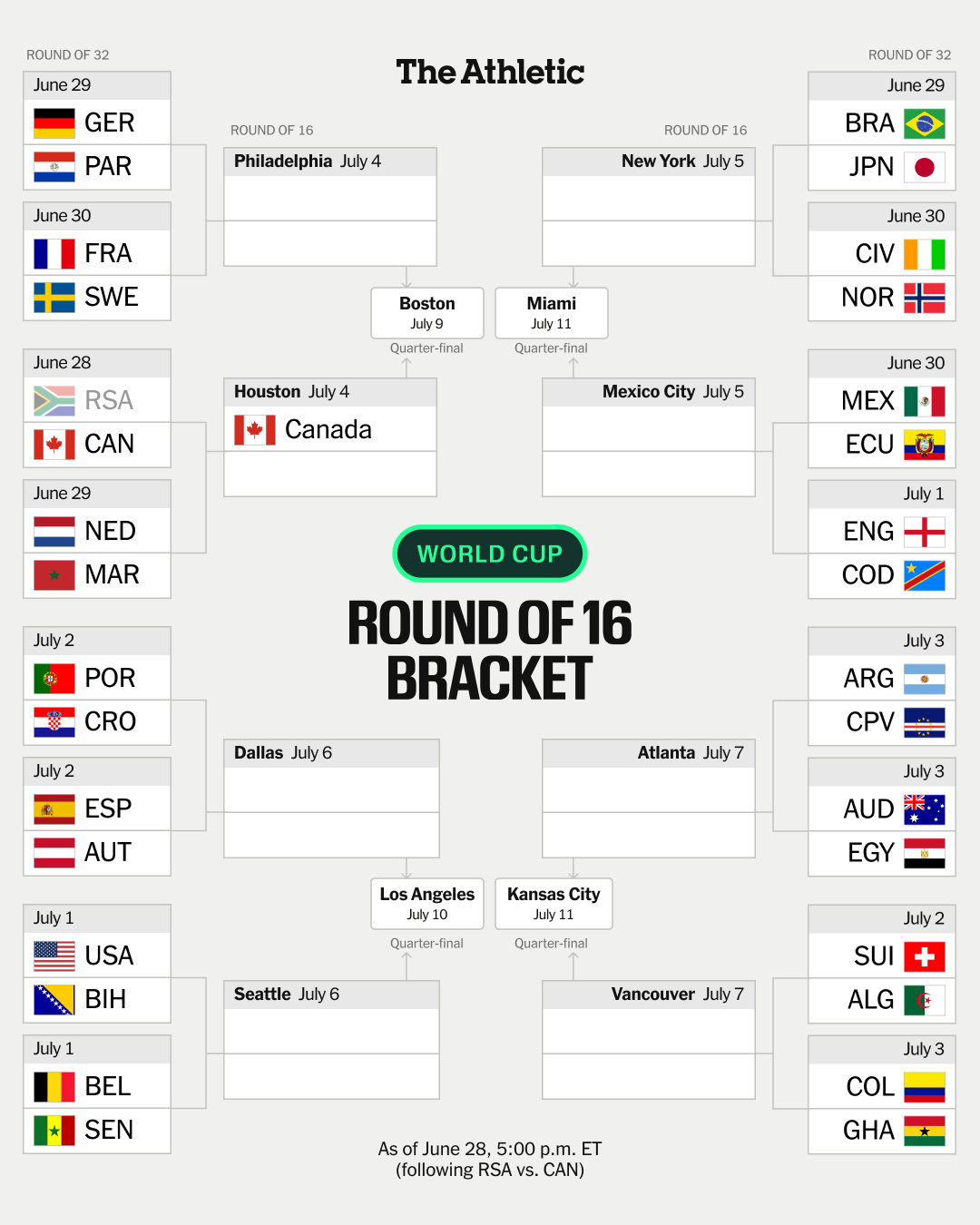
Sunday brought an unusual situation to this World Cup, featuring only one match amidst other days packed with games. This was due to scheduling needs. The third-placed teams were decided only the night before, making it impossible to schedule their games on Sunday. Organizing fixtures for winners and runners-up also involved ensuring fair rest periods since their last group stage games.
The sole match on Sunday saw co-hosts Canada secure a dramatic last-minute victory over South Africa. This was Canada’s first-ever win in a men’s World Cup game. Jesse Marsch, the Canadian coach, praised his players as ‘Canadian heroes’ after the match. Canada now prepares to face either Morocco or the Netherlands in the next round.
While the game didn’t feel like a typical World Cup knockout, it ended with a noteworthy moment. Stephen Eustaquio, taking advantage of a poor clearance with only seconds left, scored a goal that ensured Canada’s place in the final 16.
One lingering question is whether knockout games will maintain the goal thrill of the group stage. The knockout phase typically brings defensive strategies and reserved play to avoid risks leading to elimination. Players might conserve energy, wary of potential extra time. Many hope for livelier matches ahead.
Europe versus South America?
Recent international tournaments often create an imbalanced bracket. Euro 2024 had several strong teams in one half, while World Cup 2018 followed a similar pattern. However, this World Cup is different. FIFA’s seeding method aimed to balance the brackets, ensuring top teams avoid meeting before the semi-finals.
The top half of the draw, featuring France, Spain, Netherlands, Germany, and Portugal, seems more challenging. The bottom half, containing Argentina, England, and Brazil, lacks some expected challengers, primarily because of Portugal’s second-place finish and Uruguay’s absence this year.
The draw presents a Europe versus South America scenario. France, Spain, Netherlands, Germany, and Portugal dominate the top bracket, with Argentina and Brazil in the bottom. England, noted for some shaky performances, will face a tough road ahead that could include Mexico, Brazil, and Argentina.
Upcoming Matches on Monday
Seventy-three matches in, and World Cup 2026 now seems to reach its pivotal moment. Only Uruguay, a traditionally strong nation, has been eliminated so far. On Monday, at least two prominent teams will exit the tournament.
The day begins with Brazil facing Japan. Brazil, with a rich history but a lengthy World Cup drought, goes against Japan, a side known for cohesive play yet never victorious in knockout ties. Japan strives to translate promising plays into goals.
Next is Germany versus Paraguay. Germany, despite a lackluster start, finds a relatively easier opponent in Paraguay, making it a good time for viewers to step away for a break if needed.
The final match pits the Netherlands against Morocco. The Netherlands, a frequent finalist, plays against Morocco, who enjoyed a successful run in the last World Cup. Notably, several Moroccan players have strong connections to the Netherlands, adding an intriguing dynamic.
This is the inaugural round of 32 for a World Cup, replacing the previous group stage transition to 16 teams. Underdogs have a new opportunity to create surprising outcomes.
Today’s game schedule:
- Brazil vs Japan at 1pm ET; 6pm BST
- Germany vs Paraguay at 4:30pm ET; 9:30pm BST
- Netherlands vs Morocco at 9pm ET; 2am BST