
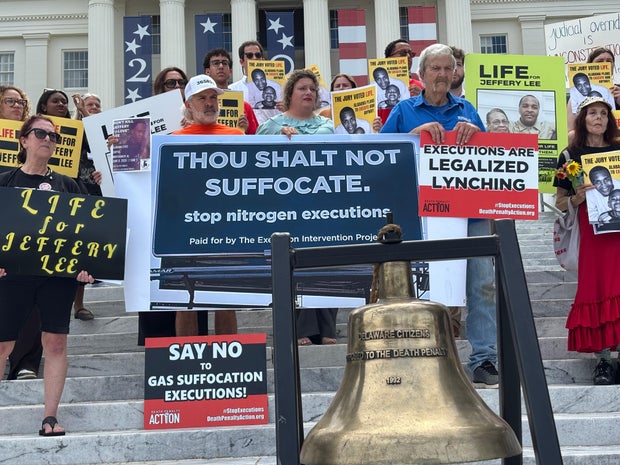
A federal judge has prohibited Alabama from executing death row inmate Jeffrey Lee using nitrogen hypoxia. This decision reverses a previous ruling that declared the method, considered controversial and new, as constitutional.
The verdict issued on Tuesday stops Alabama from using nitrogen gas to carry out Lee’s death sentence. Lee, 49, was set to be executed on Thursday. He has been on death row for over twenty years after being convicted in 1998 for a double murder.
In 1998, prosecutors accused Lee of killing Jimmy Ellis, a store owner, and Elaine Thompson, an employee, during a robbery attempt. Legal documents confirm these charges.
“Lee has shown by a preponderance of evidence that the Protocol constitutes cruel and unusual punishment,” Judge Emily Marks stated in her opinion, referring to the recent appeals court decision.
The decision follows an appeals court ruling from Monday that overturned Marks’ earlier judgment affirming the execution method. The U.S. District Judge argued that Alabama’s protocol contradicts the Eighth Amendment, which prohibits cruel and unusual punishment.
In April, during a bench trial examining the constitutionality of Alabama’s nitrogen hypoxia procedure, experts testified about its effects. The court concluded that inmates likely endure “severe air hunger and emotional distress, anxiety, physiological stress, and physical discomfort” for one to three minutes before death occurs.
“There is, in other words, a substantial risk of serious harm. The risk is not conjectural, speculative, or doubtful,” the court’s opinion emphasized.
Marks’ ruling is significant for ongoing challenges against capital punishment in Alabama, especially since the state started nitrogen hypoxia executions in 2024. Despite the difficulty for inmates and attorneys to provide sufficient proof, this new decision marked progress.
To challenge an execution method under the Eighth Amendment, the Supreme Court requires inmates to prove that it poses “a substantial risk” of severe pain. Additionally, they must propose a viable alternative method.
Lee suggested execution by firing squad as an alternative to nitrogen hypoxia. Marks acknowledged this method as “feasible, readily implemented, and significantly reduces the substantial risk of serious harm.” Though Alabama has yet to authorize firing squads, current legal sentences can involve lethal injection, nitrogen hypoxia, or occasionally electrocution.
The state, led by Alabama Attorney General Steve Marshall, intends to appeal against Marks’ decision, court documents show. Critics doubt the nitrogen gas method’s safety, yet Alabama maintains it does not cause undue suffering.
Had Lee’s execution proceeded, he would have been the ninth in the U.S., and the eighth in Alabama, executed through nitrogen hypoxia. One such execution has occurred in Louisiana.
The Supreme Court may now review Alabama’s nitrogen gas execution protocol. To date, it has never deemed any capital punishment method unconstitutional.