
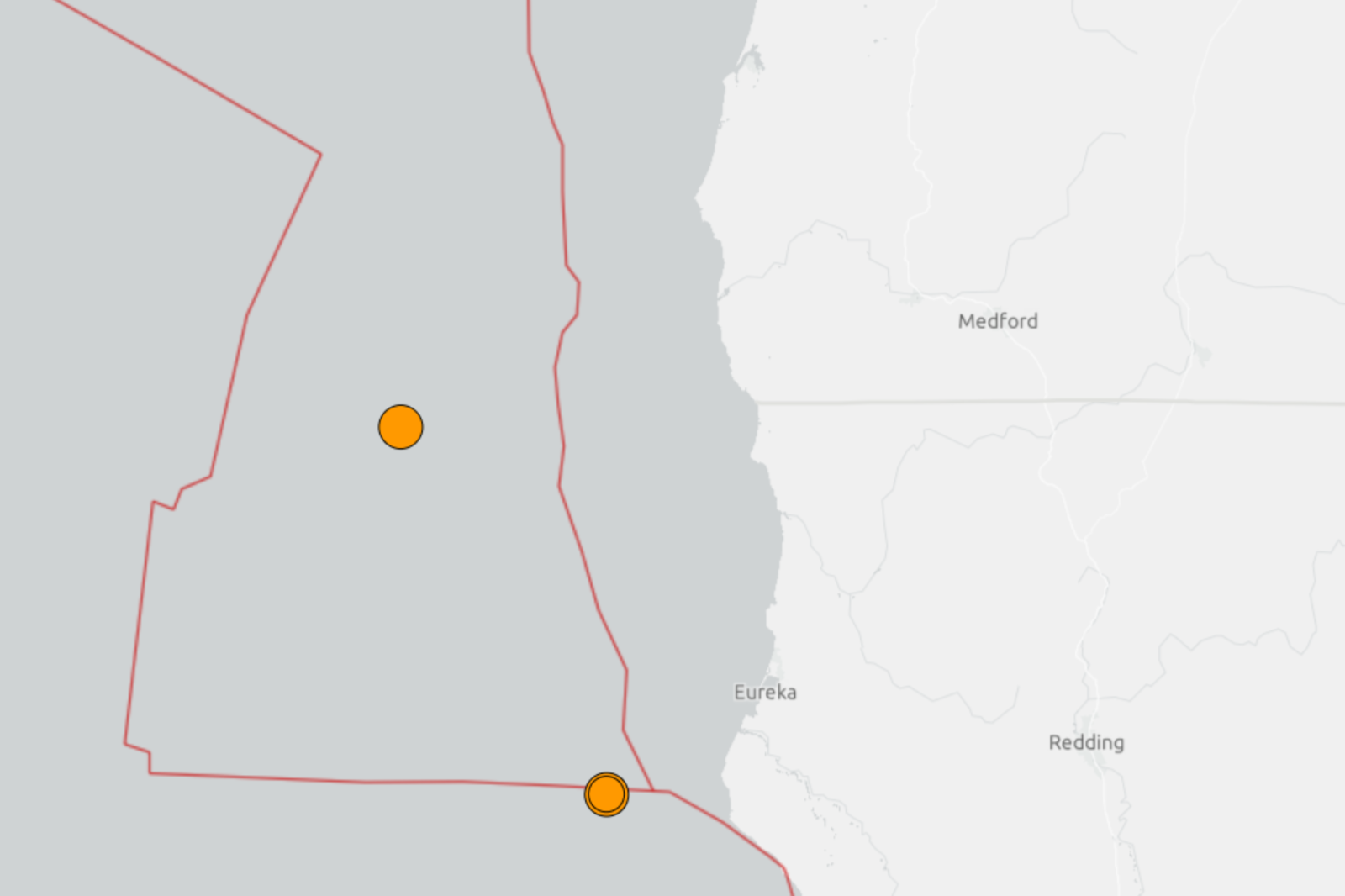
A sequence of offshore earthquakes, with two measuring magnitude 5.0 or higher, hit the Pacific Ocean near Northern California early Wednesday, according to the U.S. Geological Survey (USGS).
Where Did the Earthquakes Strike?
A magnitude 5.7 earthquake struck off the Oregon coast earlier in the day, located about 100 miles west-southwest of Pistol River. Following this, a 5.1 magnitude quake occurred approximately 40 miles west of Petrolia, California, at a shallow depth of about .12 miles.
This initial quake was followed by tremors measuring 4.5 and 2.8 in magnitude at the same location, along with a smaller 1.8 magnitude quake recorded around 11 miles west of Petrolia. Although these earthquakes had the potential to be felt along the coast due to their shallow nature, reports indicated limited effects. Officials confirmed no tsunami warnings, threats, major damage, or injuries.
Dozens of Smaller Earthquakes
Recently, California has experienced a series of smaller quakes, totaling 82 as measured by the USGS. Northern California recorded at least 35 quakes of magnitudes from 0.03 to 3.6, mostly north of Santa Rosa near Mercuryville, an area with noticeable activity in recent months. Additionally, 47 small earthquakes ranging from .3 to 2.5 in magnitude were observed from Parkfield in the north to Imperial in Southern California.
Why Are Earthquakes Common in California?
Earthquakes are widespread in California primarily because it lies on a significant tectonic plate boundary, one of the world’s most active. The state is positioned between the Pacific Plate and the North American Plate. These large crust sections move past each other along faults such as the San Andreas Fault.
This movement is not smooth, as friction causes the plates to become stuck temporarily, leading to stress accumulation underground. When this stress is suddenly released, it results in an earthquake.
California’s seismic activity is further complicated by its extensive fault network, beyond just the San Andreas. This network distributes seismic activity throughout the state, allowing earthquakes to occur in multiple regions, rather than along a single fault line.