
New York (AP) – Your favorite jeans likely traveled extensively before landing in your closet. These jeans, while possibly never worn, undergo treatments such as stonewashing, sanding, fading, or laser processing to appear used. These processes consume significant water, energy, and chemicals.
The fashion industry, one of the largest greenhouse gas emitters, has focused on making denim more sustainable. Brands often label their jeans as sustainable, using regenerative cotton, recycled fibers, and low-water techniques. Determining their sustainability, however, is complex due to the lack of universal standards.
Denim Production and Challenges
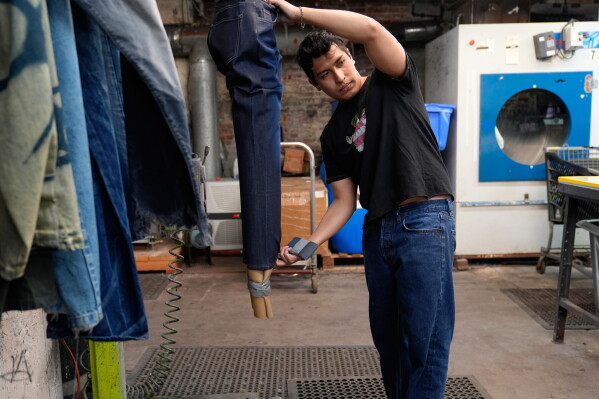
Bryan Morales Ibarra, working at BPD Washhouse in Jersey City, N.J., uses ozone in the distressing process, reducing traditional chemicals and water usage.
Recently, Shein, a Chinese fast-fashion brand, acquired the transparent and sustainability-oriented brand Everlane. This highlights the tension between sustainability costs and fast, affordable fashion. Consumers must consider tradeoffs regarding farming, chemicals, and labor ethics.
Most jeans use cotton, a water and pesticide-intensive crop. Beth Jensen of Textile Exchange notes many brands lack full transparency on their cotton sources. Production often spans various countries, complicating labor condition checks.
Some brands now focus on regenerative cotton to improve soil health and biodiversity. However, what works in California might not suit climates in places like India or Australia.
Labor and Energy Intensive Denim Production
After harvesting, cotton is spun into yarn, dyed usually with indigo, and woven into denim. Bill Curtin of BPD Washhouse explains that denim finishing involves “wet” and “dry” processes. The “wet” process uses significant water and chemicals, traditionally employing stones from Mexico for stonewashed looks. Advances now include enzyme-based alternatives and ozone technology, reducing water needs.
The “dry” process adds abrasions and details either manually or with lasers, which Curtin points out as more efficient. Many stretch jeans incorporate synthetics like polyester that can shed microplastics.
Efforts in Sustainable Denim
Maria McManus, a fashion designer, found traditional denim washing processes too invasive in water and chemicals. She opted for raw Japanese indigo denim, skipping the wash stage for a unique, unprocessed look. Collaborating with Agolde provided access to vetted supply chains and biochemical dyes, though challenges persist, such as crop failures and supply chain verification.
McManus emphasizes trust in suppliers who honestly disclose such challenges. Her denim line’s high prices reflect small production runs rather than unverified sourcing.
Choosing Sustainable Denim
Experts advise examining brands for transparency in sourcing and manufacturing across their entire lines, not just in limited collections. Dana Davis, a strategic fashion adviser, warns of greenwashing and suggests looking at brands for comprehensive discussion on labor rights and textiles.
Certifications like B Corp, evaluating social and environmental performance, and Forest Stewardship Council (FSC) vetting for lyocell fibers, offer guidelines. Levi Strauss & Co. reports that if 34.2 million people bought secondhand jeans instead of new ones, significant carbon emissions could be avoided.
Beth Jensen stresses the importance of buying fewer jeans, wearing them longer, and choosing secondhand.
The Associated Press’ climate and environmental coverage, supported by private foundations, remains solely responsible for its content. More information is available at AP.org.