
The U.S. military is in a state of confusion as it awaits clarification from the Pentagon following President Trump’s inconsistent directives regarding troop deployment in Europe. This situation disrupts military personnel’s lives and potentially incurs substantial costs to taxpayers.
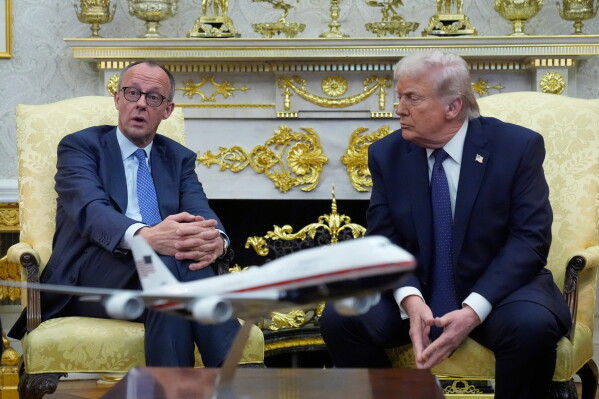
NATO allies expressed their concern in May when President Trump announced the deployment of 5,000 U.S. troops to Poland, shortly after ordering a similar number withdrawn from Europe. This decision was linked to a disagreement with Germany’s Chancellor Friedrich Merz over the Iran conflict. The Trump administration maintains that troop reductions in Europe have been planned and discussed with allies.
Social media was abuzz with President Trump’s announcement of sending troops to Poland; this happened on the same day the Pentagon officially canceled the rotation of soldiers to the region. One defense official noted that equipment for the unit had already been dispatched, costing the military $32 million according to U.S. Transportation Command, responsible for global troop and gear movement.
The abrupt changes require the military to “retroactively engineer” a policy in line with the President’s latest directive, the official stated.
European allies are concerned about the potential message this sends to Russia, and the impact on American troops’ morale is significant. Some troops faced canceled deployments shortly before leaving, while those already dispatched await confirmation of their return.
The cancellation memo issued at the beginning of May affected the rotational deployment of 4,000 troops from the Army’s 2nd Armored Brigade Combat Team, based in Fort Hood, Texas, to Poland. Allies were informed mid-month, leading to confusion over troop movements.
Regarding President Trump’s order to send 5,000 troops to Poland, details remain unclear. It is hypothesized that these troops could be reallocated from existing units within Europe rather than additional U.S. deployments.
The U.S. Transportation Command faced logistical challenges transporting equipment to and from Europe. The cost of the incoming team’s equipment was considerable, with the chartering of a ship accounting for $32 million.
Joe Costa, the director of the Atlantic Council’s Forward Defense program, emphasized that the unscheduled return of personnel and equipment poses financial and readiness challenges. Costs related to deployment cancellation clauses in contracts with private companies lead to additional fees.
John Deni, a senior nonresident fellow at the Atlantic Council, highlighted the complexity of calculating costs resulting from reversed decisions and logistical changes.
The Pentagon has not commented on the financial implications of altered deployment plans, despite planning to reduce troop levels for Europe’s security self-sufficiency.
Additionally, a deployment to Germany was canceled for a battalion trained to fire long-range rockets and missiles.
Troop removal from Germany could reach billions in costs due to lacking infrastructure in the U.S. for accommodating these personnel and their families.
Costa noted that breaking up a unit to move personnel and equipment separately imposes readiness costs. This affects morale and disrupts soldiers’ and families’ plans.
The ambiguity surrounding U.S. troops in Europe continues, with options including reallocating military units from Germany to Poland—an endeavor that could take years and incur further expenses.
Amidst these operations, the Army is experiencing a budget shortfall ranging between $2 billion and $6 billion. Training course cuts nationwide are one of the consequences of this deficit.
The Army has issued guidance to prioritize critical requirements such as major training and readiness events.
Additional missions, including the National Guard deployment in Washington and operations at the U.S.-Mexico border, are straining the budget further. While the Department of Homeland Security anticipates reimbursement for the border mission, no payment has been received yet.
The U.S. military in Europe is facing reductions in non-combat training support as it focuses on essential functions.