
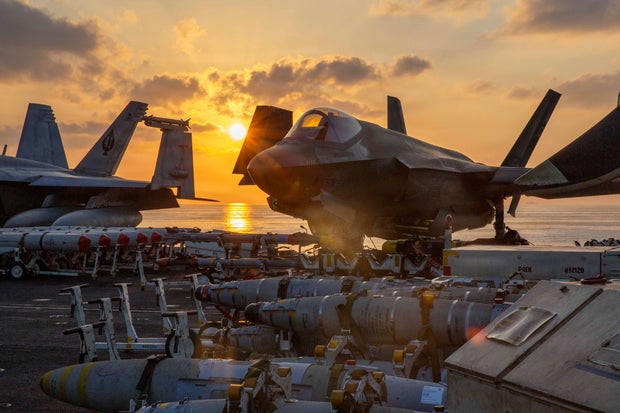
The Defense Department’s inspector general has unveiled a critical issue facing the United States. A mandatory report submitted to Congress on Monday highlights a significant shortfall in ammunition due to ongoing military operations in Iran.
Detailed in the report, Operation Epic Fury (OEF), which ran from February 28 to June 30, 2026, incurred costs totaling $33.4 billion. A substantial $22.3 billion of this amount was allocated to munitions expenditures alone. The report brings to light the strategic inventory shortfall and points to bottlenecks in the munitions resupply process.
The munitions expenditure on OEF has resulted in strategic inventory shortfalls and revealed industrial base bottlenecks for munitions resupply.
Throughout the operation, the U.S. faced the destruction and damage of several key military assets. The losses included four destroyed F-15 fighter jets, one damaged F-35, seven damaged KC-135 tanker aircraft, and as many as 30 MQ-9 Reaper drones lost.
President Trump has consistently dismissed concerns about the depleted weapons stores over the six months of conflict in the Middle East. Just weeks ago, he asserted that the U.S. boasts “virtually unlimited” ammunition. Reaffirming this stance, Trump posted on Truth Social that the nation is producing “more Exquisite and Elite Weapons than at any time in our History.”
In the initial 24 hours of the conflict with Iran, U.S. forces targeted over 1,000 locations. According to U.S. Central Command (CENTCOM), such large-scale attacks have not been repeated in recent months.
The report also documents significant damage from Iranian strikes. These strikes led to the destruction of numerous buildings and structures across U.S. military bases located in Kuwait, Bahrain, Qatar, UAE, Saudi Arabia, Iraq, Oman, and Jordan. However, the report omitted these damages from the total cost estimates since the reconstruction plans and financial responsibilities remain undecided.
Recently, CBS Sunday Morning was given access to Lockheed Martin’s Arkansas production facility. Here, the latest model of the Patriot air defense missile was showcased. This missile, capable of intercepting ballistic missiles, costs around $4 million each. Lockheed Martin’s current production rate stands at 750 units annually.
When questioned about the sufficiency of weapons for the conflict, Mark Cancian of the Center for Strategic and International Studies commented that the U.S. can sustain a war against Iran. However, sustaining a prolonged conflict with China poses a significant challenge, possibly exceeding available munitions within a few months.
The Pentagon has officially refuted claims of a munitions shortage. Nonetheless, Defense Secretary Pete Hegseth has urged the defense industry to accelerate weapons manufacturing. Tim Cahill, heading Lockheed Martin’s missile division, described the manufacturing process as “controlled chaos,” emphasizing the need for quick problem-solving.
The focus remains on rapid production and addressing any obstacles to ensure U.S. military readiness.