
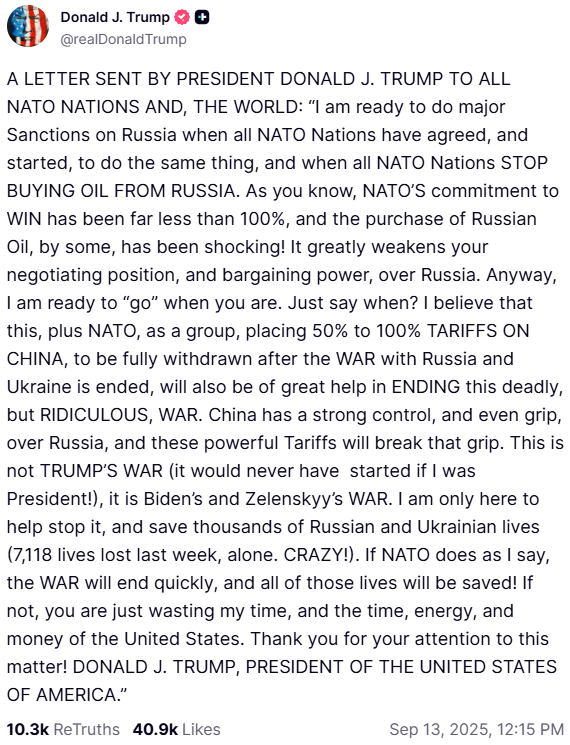
A year ago, Donald Trump advocated for NATO countries to cease purchasing Russian oil. On September 13, 2025, he remarked on Truth Social that such actions weakened the alliance’s influence over Vladimir Putin. Trump suggested that NATO should implement hefty tariffs on China and considered imposing significant sanctions on Russia if necessary.
Fast forward one year, and Trump’s message shifted when addressing Ukraine. He urged President Volodymyr Zelensky to halt attacks on Russian diesel fuel supplies, citing the impact on global prices, which had reached $6 per gallon.
This is not TRUMP’S WAR,he had previously stated, yet showed a willingness to participate. Now, he is immersed in conflict in the Middle East.
Operation Epic Fury, launched by Trump on February 28, aimed to prevent Iran from acquiring nuclear weapons and cripple its missile capabilities, navy, and air force. The operation has significantly affected the energy market, influencing Trump’s policies on Russia and affecting U.S. fuel prices.
The International Energy Agency reported that over 10 million barrels of Gulf oil production were halted in August. Gulf oil exports were reduced to half their prewar levels, with diesel and gasoline exports averaging just 390,000 barrels a day—far below previous figures.
The outlook remains grim. Washington and Tehran still lack an agreement on the Strait of Hormuz. Meanwhile, Iran’s allies are exerting pressure on the Bab el-Mandeb Strait.
Recent activities by Yemen’s Houthi rebels have intensified the situation. They attacked Saudi infrastructure and seized the strategic Red Sea port of Mokha and Mayun Island. Subsequently, Saudi Arabia closed its East-West pipeline after drone attacks originating from Iraq.
These conflicts are impacting the U.S. consumer market. Diesel prices have risen from $3.72 per gallon in February to $5.97 in August, with a national average of $6.20 as per AAA.
Within the U.S., this has affected Trump’s administration. Pew Research reported in July that 60% of Americans felt Trump’s economic policies worsened conditions, with increased concern over gasoline prices.
Currently, Trump’s request to Ukraine seems driven by self-interest. In Washington, it resembles an attempted deal. For Ukraine, preparing for its fifth winter of war, it might seem unreasonable.
Russia’s threat to Ukraine persists. On September 1, Putin ordered intensified strikes on Ukraine’s energy infrastructure. Russian forces possess advanced weapons that challenge Ukraine’s defenses.
In addition, the upcoming Russian elections pose another challenge. Moscow may soon escalate its military efforts, affecting Ukraine, which already faces shortages.
For Ukraine, targeting Russian oil infrastructure remains a strategy to impose costs on Russia. Yet, Trump is now discouraging Zelensky, despite Ukraine managing to acquire leverage over Russia.