
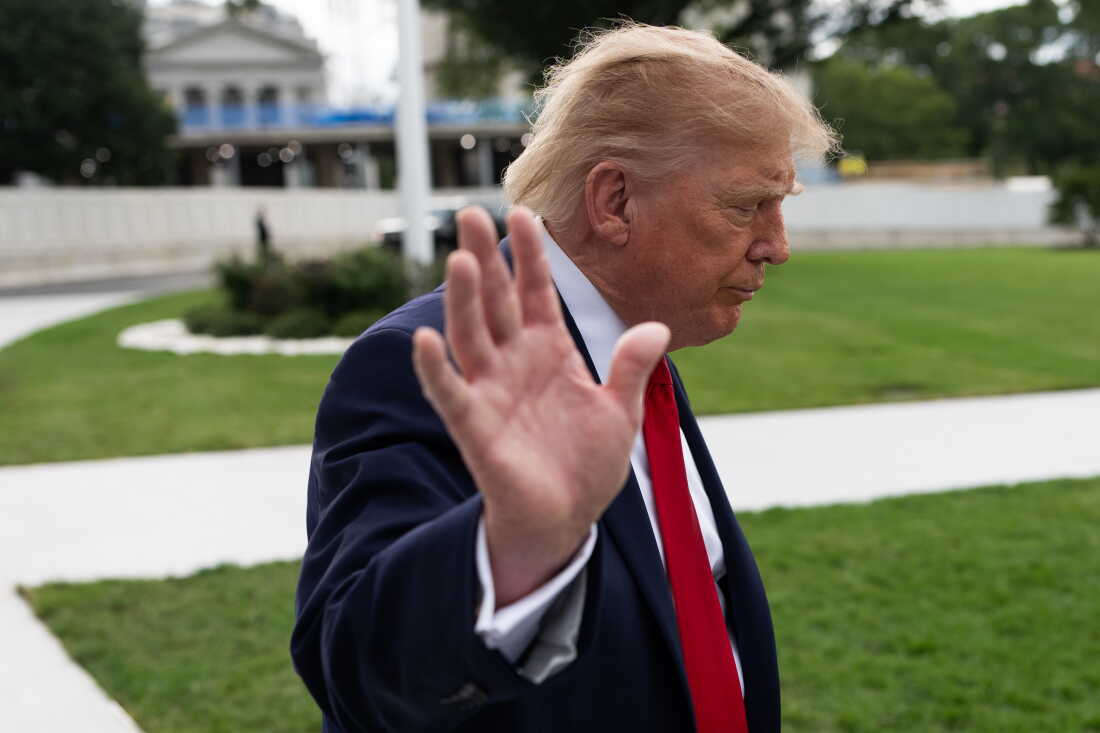
President Trump appeared on the South Lawn of the White House on September 26, 2026, addressing the media before traveling to Knoxville, Tennessee, for a college football game.
Trump announced his decision to reject an Iranian plan to reopen the Strait of Hormuz. He stated that the proposed deal ‘would not be acceptable,’ but did not provide further details. Trump remarked, ‘I like making a deal too. But that deal would not be acceptable.’ He suggested that Iran sought the deal due to significant losses. Iran presented this proposal during the United Nations General Assembly in New York.
Iranian Foreign Minister Abbas Araghchi revealed on Friday that Iran had shared a ‘concrete seven-day plan’ with the U.S., through Qatar, to reopen the strait. This followed Iran’s closure of the strait after attacks by the U.S. and Israel on February 28. The closures have caused substantial disruptions in global oil supply.
Araghchi outlined that ‘if the necessary conditions are met, the strait can be reopened and normal maritime passage restored within seven days.’ He emphasized that the decision now lay with the United States.
The Iranian proposal resembled an earlier agreement in June—a memorandum of understanding (MoU)—between the U.S. and Iran. This agreement aimed to halt hostilities and resume ceasefire discussions. In exchange for reopening the strait, Iran was promised relief from a U.S. naval blockade, reduced sanctions, and access to frozen assets. In return, Iran assured it would refrain from developing a nuclear weapon. However, disputes over unclear terms in the MoU led to its collapse, resulting in renewed U.S. and Iranian strikes shortly after.
Araghchi urged the U.S. to adhere to its earlier commitments as outlined in the MoU. ‘The actions that the United States should take are not new; they are all already in the MoU,’ he stressed.
In an upcoming CBS interview, Iranian President Masoud Pezeshkian stated Iran’s willingness to honor its commitments, provided the U.S. demonstrates it has no intention of undermining Iran’s government.
Pezeshkian highlighted the necessity for both sides to clear the path towards negotiation, emphasizing, ‘If the United States agrees to proceed in that way, everything will return to the way it was before.’ He added that rekindling nuclear talks and allowing U.N. inspectors were conditional on U.S. acceptance of Iran’s proposal to reopen the strait.
Contributions to this report were made by NPR’s Hadeel Al-Shalchi and Emily Feng.