
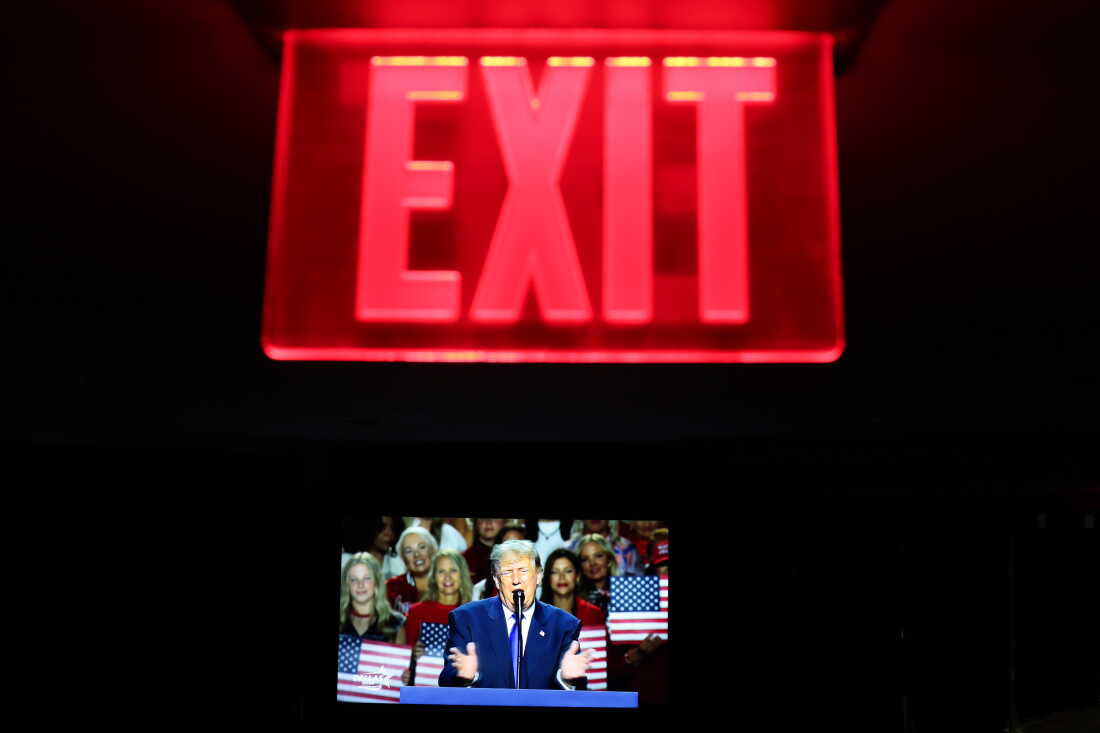
President Trump addressed attendees on the first day of the 2026 Republican convention on September 9 in Dallas. A noticeable trend has emerged within the Republican Party: dissent against Trump’s agenda. Despite his emphasis on loyalty, more candidates and elected officials have begun to distance themselves from his policies. These include calls to end the U.S. conflict with Iran and provide economic relief amid rising prices. Criticism of his immigration handling is also notable.
This dissent arrives at a pivotal moment for the GOP. With less than 40 days until voting concludes, the party strives to maintain its narrow majority in Congress. Control of both the Senate and House hinges on a few closely contested races.
Trump’s influence looms over the midterms. He urges voters to act as though he’s on the ballot, despite low approval ratings. The NPR/PBS News/Marist poll indicates that 45% of registered voters, including a majority of independents, see their vote as opposition to Trump.
“Trump’s strength derives from his connection to voters,” said GOP strategist Sarah Longwell. “Republicans hesitate to oppose him due to his stronghold on the party.”
However, as public opinion of Trump declines, Longwell believes that GOP lawmakers and candidates might “feel more comfortable opposing policies they care about.” Dissent isn’t limited to the campaign trail. Utah Republican Sen. John Curtis, not up for reelection until 2030, urged an investigation into Donald Trump Jr.’s wedding funding, citing a Russian oligarch’s involvement. This reflects a possible shift, suggesting an increasingly fragile support for Trump.
Campaign Trail Divides
Polls show Americans prioritize cost of living concerns. Republicans running in toss-up races this cycle are acknowledging this connection. GOP Senate candidates Ashley Hinson from Iowa and Mike Rogers from Michigan recently voiced opposition to the war and advocated for economic relief.
“Iowans are squeezed economically and shouldn’t bear the conflict’s costs,” Hinson declared online, emphasizing the need for a swift resolution. This marks a departure from previous opposition to ending the conflict.
Rogers linked rising everyday costs to the conflict in a video, emphasizing the need for reduced prices. Neither candidate directly mentioned Trump, yet their statements contrast with the White House’s stance, as Trump consistently defends his Iran policy and downplays its economic impact.
Dissatisfaction with the Iran war grows in Congress. Recently, seven House Republicans joined Democrats in supporting a resolution to withdraw U.S. forces, increasing from four earlier this summer.
“Facing electoral trouble, Republicans feel compelled to differentiate themselves,” noted GOP strategist Ron Bonjean. “They’re keen to highlight their independence from Trump.”
This newfound independence could prove vital for Republicans courting key voting blocs, including Hispanic voters, who have distanced from Trump despite supporting him in the past.
In red states like Texas and Florida, Hispanic-dense districts report waning Republican backing, as highlighted in a New York Times/Siena survey. This includes Florida’s 27th district, where Rep. María Elvira Salazar, seeking a third term, critiques Trump’s immigration policy.
“Hispanics who backed you in 2024 feel betrayed,” Salazar cautioned Trump’s advisers.
Although Salazar marked a clear break, she still engages carefully. In a CBS News interview after her ad release, she described a “fantastic conversation” with Trump, portraying him as “receptive.”
“I offer insights as a South Florida Congress member,” she explained. “Some advisers aren’t giving the full picture.”