
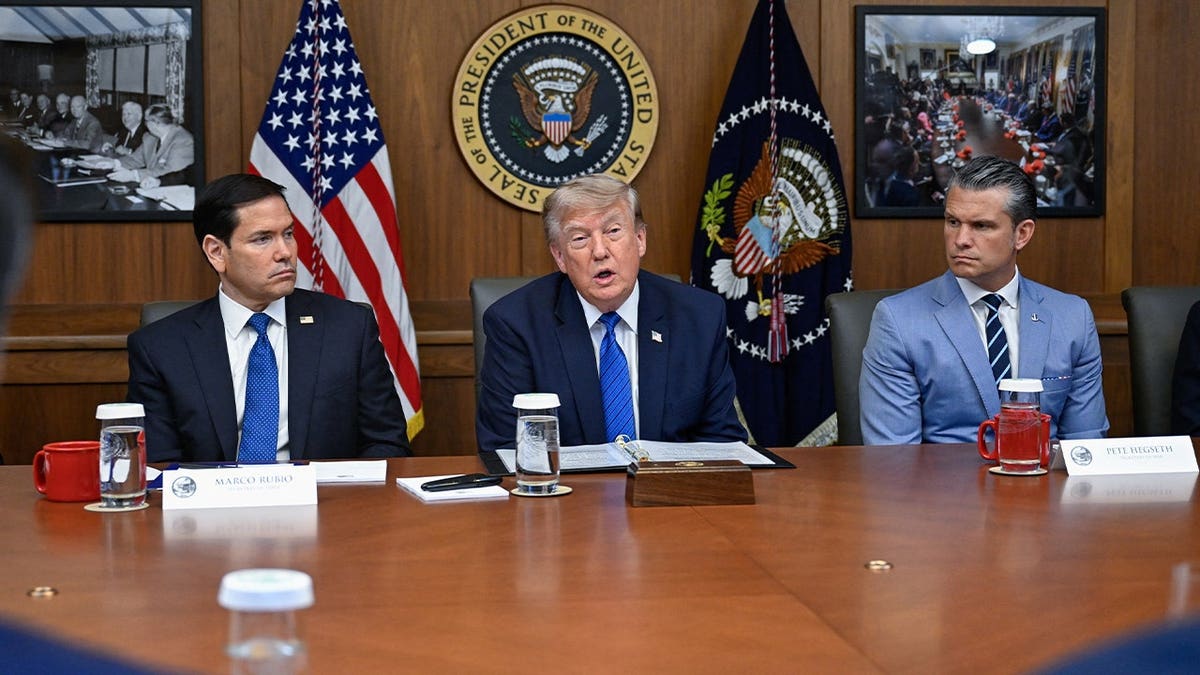
President Donald Trump stated on Friday that Americans should be ready for ongoing conflicts with Iran. He anticipated that Tehran would eventually weaken as U.S. attacks reduce its ability to retaliate.
When asked if the exchanges would continue until Iran loses its striking capability, Trump responded, “Yeah, sure, I think so. I’d be foolish to say no. You know, you always have to keep your guard up.” He added, “They’ll get weaker. They’ll get a little stronger, maybe. But they’ll get weaker, and then they peter out.” These remarks were made during a Cabinet meeting at Camp David, Maryland.
President Trump emphasized that Americans should prepare for the ongoing struggle with Iran.
These statements acknowledged that the several-month-long conflict might persist. This comes despite Trump’s assertions that the U.S. has weakened Iran’s military and his recent optimism for renewed negotiations.
“I think we just want to win,” Trump remarked. “We’re doing very well. We’re trying to be nice, but they’re being decimated.” He mentioned Iran’s lack of a navy, air force, and anti-aircraft capabilities. “It doesn’t mean they don’t have any capability. They have some, but very little.”
The recent fighting poses challenges to previous U.S. claims that Iran’s military power projection is diminished. In April, the White House announced U.S. forces had achieved the objectives of Operation Epic Fury, targeting Iran’s Navy and missile capabilities. Nonetheless, Iran continues missile and drone launches against U.S. bases and commercial shipping threats.
Trump also expressed doubts about reaching a deal with Iran, accusing them of dishonesty in talks with the U.S. He said, “They do lie, and they do misrepresent. All they do is make me angry.”
The continued hostilities create an uncertain end to the conflict as the U.S. nears the November midterm elections. This heightens political pressure on Trump to clarify the war’s conclusion. The strategic Strait of Hormuz, a key location, remains a focal point.
Two days prior, the U.S. launched a significant wave of strikes on Iranian sites following Iranian missile attacks. U.S. Central Command reported striking several Revolutionary Guard targets, including command centers and facilities related to missiles and drones.
The revived conflict follows a collapsed agreement from June meant to end the fighting and restore Strait of Hormuz traffic. Hostilities resumed in July after Iran targeted vessels in the area. Central Command confirmed further airstrikes on July 17, 2026.
Previously, Trump expressed optimism, stating the U.S. was in “very friendly negotiations” with Iran and expected a “good chance” at reaching an agreement. While Iran denied direct talks, mediators are reportedly relaying messages. Efforts by Oman, Qatar, Pakistan, and Egypt to restore the June agreement face obstacles over waterway control, sanctions, and Iran’s nuclear ambitions.