
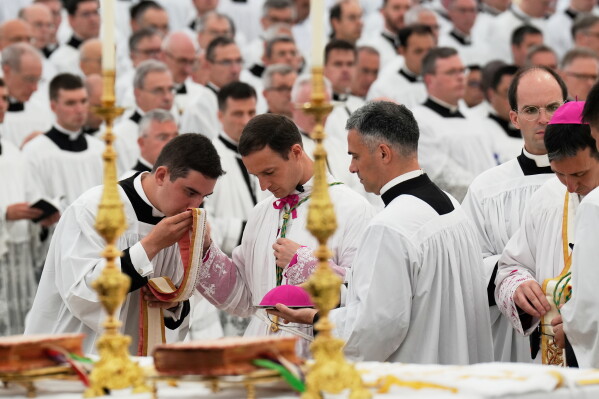
In a service filled with incense and tradition, the Church of Saint Agnes in St. Paul, Minnesota, seeks to blend old Catholic customs with allegiance to the Vatican. The priest, Rev. John Ubel, emphasizes the significance of maintaining a connection to the past while adhering to current Vatican guidance. With both English-language and Latin Masses, Ubel addressed the topic.
The modernization of the liturgy more than six decades ago by the Second Vatican Council created divisions. Some Catholics view the traditional Latin Mass as a symbol of these divides. Recently, Pope Leo XIV confronted issues with the Society of St. Pius X (SSPX), a group opposing the Council’s reforms. The Vatican excommunicated SSPX bishops and priests after their unauthorized consecrations, creating tension among traditionalists.
Saint Agnes, though not affiliated with SSPX, has permission to conduct Latin Mass. Rev. Ubel urged those who value tradition to maintain full communion with Pope Leo XIV. The church serves the local community and offers a variety of Mass forms, from Latin to modern English versions. Ubel sees this as a model for the church, respecting different liturgical traditions.
Some parishioners, like 15-year-old Peter Draganowski, prefer the traditional Latin Mass. Despite its complexity and additional rituals, he finds beauty in its intricacy. Archbishop Bernard Hebda expressed hopes that those attending SSPX services will join approved Masses, emphasizing the availability of traditional liturgies in the region.
The Latin Mass involves unique practices. Prayers differ, priests face the altar, and Communion is given on the tongue while kneeling. Priests wear traditional vestments and biretta hats. Stephen Cranney, a Catholic University of America lecturer, notes that few U.S. Catholics regularly attend this form. However, those who do often cite its aesthetics and historical continuity as reasons for their preference.
Pope Leo XIV’s predecessors had varied approaches to the Latin Mass. Pope Benedict XVI supported it if parishioners desired. Pope Francis restricted it, requiring bishops’ approval, viewing it as divisive. Despite restrictions, Pope Leo allowed a cardinal to celebrate it at St. Peter’s Basilica, seen by traditionalists as a positive gesture.
As tensions with SSPX unfolded, Pope Leo called for unity. Parishioners of Saint Agnes, like Nell O’Leary Alt and Tom Graff, cherish the diversity of Mass forms, seeing it as part of church life rather than a hierarchy. Ubel insists on the importance of diverse Mass options, promoting inclusion and not division.