
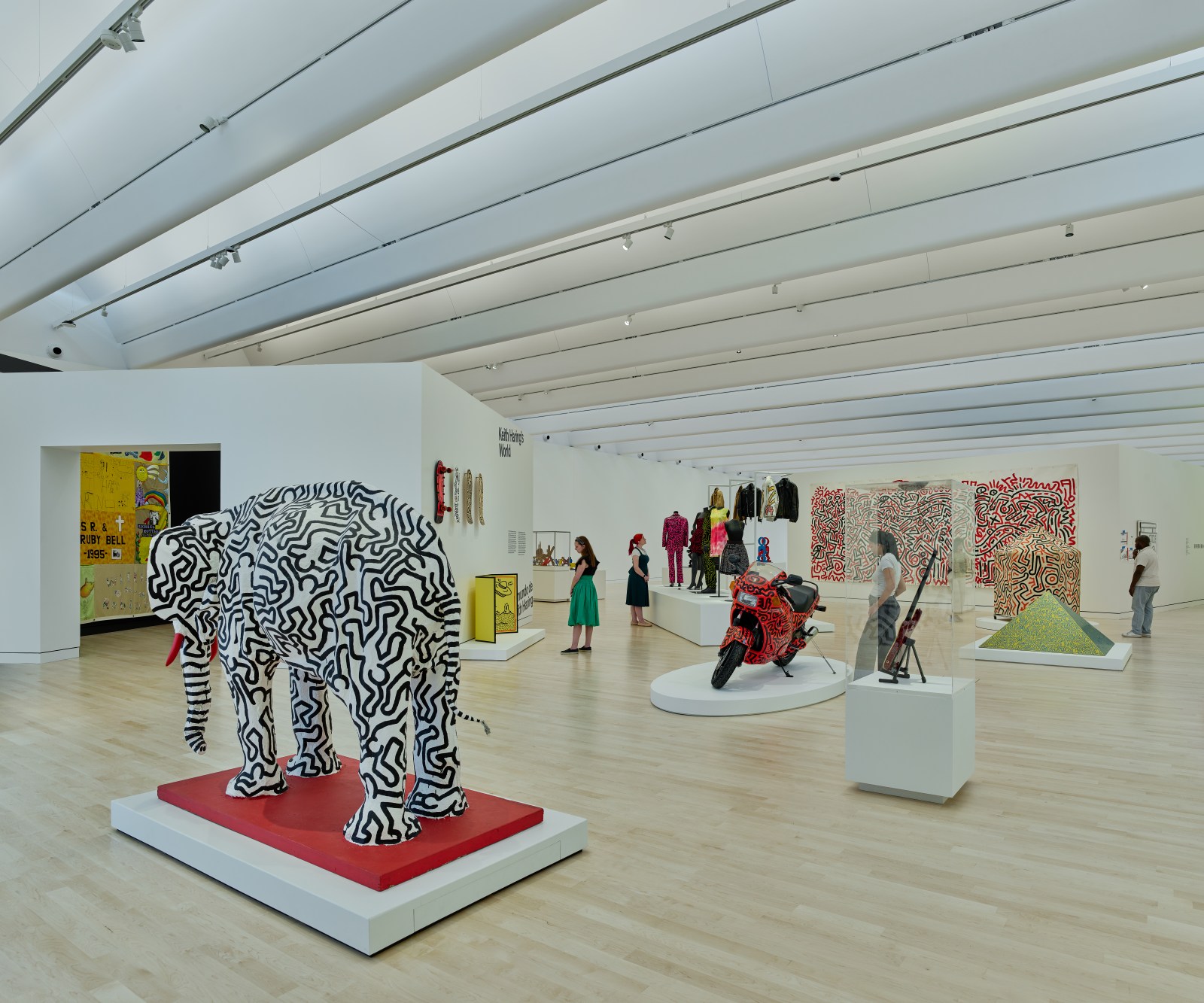
Larry Warsh’s journey as a collector began early, leading him to a deep appreciation for Keith Haring’s ability to transform lines, objects, and public spaces into a universal language. As the co-editor of the art book Keith Haring in 3D, published alongside the major exhibition at Crystal Bridges Museum of American Art, Warsh seeks to highlight the dimensions of Haring’s work that remain misunderstood. The exhibition in Bentonville, Arkansas, scheduled from June 6, 2026, to January 25, 2027, presents the first major showcase of Haring’s three-dimensional art. This includes sculptures, totems, masks, painted objects, clothing, boomboxes, and even a 1963 Buick Special, illustrating the breadth of Haring’s practice beyond traditional picture planes.
Finding a Way Into Art
Warsh’s connection to art is deeply rooted in his past. He recounts a family environment filled with objects made for scrutiny. It was his uncle who expanded Warsh’s vision, taking him to galleries and auction houses at the age of 12. These experiences unfolded the potential of objects to store history, taste, and energy. Warsh’s collecting journey began long before the downtown art scene crystallized, as he gathered a variety of items—from antiques and silver to baseball cards—driven by a perceptive eye that never faltered.
Living near Astor Place amplified Warsh’s interest. In the early 1980s New York, he was amidst artists and clubs that defined an era, including Keith Haring, Jean-Michel Basquiat, and Kenny Scharf. Proximity to this vibrant network now underscores the significance of the Crystal Bridges exhibition, emphasizing Haring’s object-based work within the downtown culture that shaped it rather than treating sculpture as a secondary aspect to his renowned paintings and subway illustrations. Warsh describes collecting as an intuitive process, requiring foresight, risk-taking, and trust in one’s instincts. Haring’s creations resonated with Warsh, possessing an intense force connected to both the artist and the evolving city.
The Downtown Triangle
The atmosphere Warsh remembers was communal and dynamic. Haring, Basquiat, and Scharf were intertwined through friendship and the vibrant downtown ecosystem where clubs, studios, sidewalks, and galleries complemented each other. The famed Fun Gallery and figures like Patti Astor converted raw energy into momentum within this sphere. Many significant individuals contributed to this vibrant network. Warsh mentions Futura, Rammellzee, Tseng Kwong Chi, and Rene Ricard as integral to the living community that helped define New York’s downtown cultural identity. Keith Haring was an active participant in this tapestry.
Art for Everyone
Warsh values Haring’s grasp of social scale. Haring understood audiences intimately, translated visually and socially. His desire was to create art that people encountered dynamically, in stores, streets, and daily life. The 1986 opening of the Pop Shop at 292 Lafayette Street carried forward the subway drawings’ logic into retail without losing the artist’s public mission. The Crystal Bridges exhibition mirrors this, demonstrating how Haring’s graphic language evolved into forms viewers could move amongst, sometimes being directly addressed.
Warsh elucidates that Haring’s engagement with commerce fits a broader lineage. Artists like Andy Warhol and Salvador Dalí set precedents by integrating art within public culture, maintaining its potency. Haring aspired to project his imagery globally, embedding it in everyday objects. His own words capture this philosophy: “The Pop Shop makes my work accessible. It’s about participation on a big level.” Warsh also underscores stewardship in extending Haring’s legacy, through museums, books, merchandise, and collaborations reaching audiences far from institutional confines.
Warsh reflects on Haring’s found-object works—painted refrigerators, doors, windows, shelves—as a testament to practicality and innovation. “Keith began by painting on what was around him,” Warsh remarks, noting canvas was sometimes unavailable. The resulting art profoundly informs comprehension of Haring’s three-dimensional approach. Crystal Bridges presents this perspective, showcasing ordinary materials transformed into sculptural surfaces, demonstrating how Haring’s lines adapted to bulk and weight without sacrificing spontaneity and humor. This evidences Haring’s integrated creative flow between medium and momentum.
Generosity as Legacy
Warsh asserts that generosity is fundamental to understanding Haring. Many exhibition pieces originate from friends, reflecting Haring’s habit of giving art away. His foundation echoes this spirit, supporting AIDS care and children’s education organizations. Warsh recounts an artist immersed in community, painting in hospitals, donating work for auctions, extending remarkable openness to the world. “He was an extraordinarily giving person,” Warsh states, emphasizing that generosity must center any discourse on Haring’s legacy.
The Crystal Bridges exhibition advances an inclusive viewpoint, showcasing sculptures and objects—often overshadowed by murals and prints—to depict Haring not merely as a painter but as an artist who instinctively engaged with spatial dimensions as effortlessly as with line. Warsh sees the exhibition’s real value in redefining Haring’s vision, exhibiting its expansive, inventive nature than the standard narrative implies.