
The story of the Titanic is well known: a grand British ocean liner that tragically sank after hitting an iceberg. However, few are familiar with the Cap Arcona, a German ship likened to the Titanic. Preceding WWII, it served as a luxury cruise liner. Once the war broke out, the Nazis repurposed it into a floating concentration camp. Anchored in Lübeck Bay, Germany, it became a site of tragedy when an aerial assault killed nearly all onboard just hours before liberation.
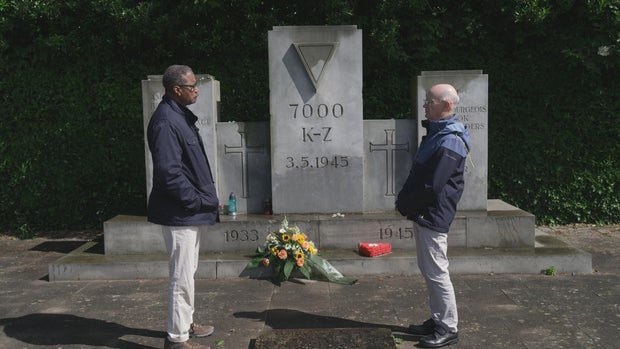
Bill Niven: This peaceful place is a graveyard. It’s the weight of history you feel here.
British historian Bill Niven, who has dedicated much of his work to the Holocaust, recounts the harrowing details at Lübeck Bay. A memorial here honors the Cap Arcona’s victims, recording the tragic loss of about 7,000 lives when both the Cap Arcona and a smaller vessel were bombed on May 3, 1945.
This memorial commemorates victims of various nationalities from the sinking of the ships, including Americans, Greeks, Italians, and Jewish people, represented by the Star of David.
Most victims were aboard the Cap Arcona, and an annual ceremony marks the attack’s anniversary, remembering those who perished and suffered. Bruno Neurath-Wilson, honoring his father Willi—a political prisoner—recalls his father’s survival. Of approximately 4,000 prisoners, only about 400 survived.
The Cap Arcona, launched in 1927, was nicknamed the ‘Queen of the Atlantic.’ The ship carried affluent passengers between Europe and South America over fourteen days. It boasted luxury facilities including a tennis court and heated pool. When Adolf Hitler rose to power in 1933, the ship’s purpose changed significantly. By 1939, it became a military barracks. Ironically, in its final civilian voyage, it transported German Jews seeking refuge in South America. Tragically, few escape routes existed for Jews during the war.
Manfred Goldberg was only 11 when forcibly taken from Kassel, Germany, alongside his family. He vividly recalls the inhumane experiences from ages 11 to 15, having survived the Riga ghetto and four concentration camps. Like many others, Goldberg lost his identity and was assigned a number—56478—essential for survival. Forgetting this would result in punishment, so he memorized it indelibly.
Goldberg and his family’s plight included forced labor and significant loss. His younger brother was taken by the SS, never to be seen again. While processing this tragic loss, Goldberg recounts reading fairy tales with his brother, thus sharing a deep bond.
George Schwab, imprisoned alongside Goldberg’s family in Nazi-occupied Latvia, had a similar experience. His father, a respected doctor, tried to protect Jews from impending SS forces but met a brutal end.
Bruno Neurath-Wilson’s father Willi, though not Jewish, opposed Nazi rule. As a political prisoner, he distributed anti-fascist literature, resulting in his imprisonment at Buchenwald and Neuengamme concentration camps. These were predominantly for political prisoners, yet survival rates were low due to exhausting work conditions.
In 1945, with Allied forces approaching, ships like the Cap Arcona were repositioned to defensive positions in Lübeck Bay. Under Heinrich Himmler’s orders, concentration camps evacuated, sending prisoners to overcrowded vessels. The Cap Arcona, fitting for 1,500, was packed with over 4,000 prisoners.
Prisoners knew the war’s end was near, sparking hope for survival.
However, the British, believing the ship carried Nazi exiles, launched an assault on May 3, 1945. In a tragic mistake, British RAF Typhoons attacked, unaware of the prisoners onboard. Despite some warnings passed to British command about the situation, no follow-up actions were taken.
The attack resulted in one of the deadliest friendly fire incidents, with about 7,000 prisoners lost. Survivors like George Schwab highlighted the resilience amidst horror. Rescued eventually, many survivors like Schwab and Goldberg chose to share their stories widely, highlighting their survival as a form of triumph over Nazi intentions.
The tragedy of the Cap Arcona has remained relatively unknown beyond Baltic regions. Memorial events continue to be held, reflecting on the story’s gravity and honoring the memory of those affected. Schwab and Goldberg used their experiences as a driving force for meaningful contributions, symbolizing endurance and remembrance. Cap Arcona, having sunk and eventually dismantled, carries a story that still demands attention.