
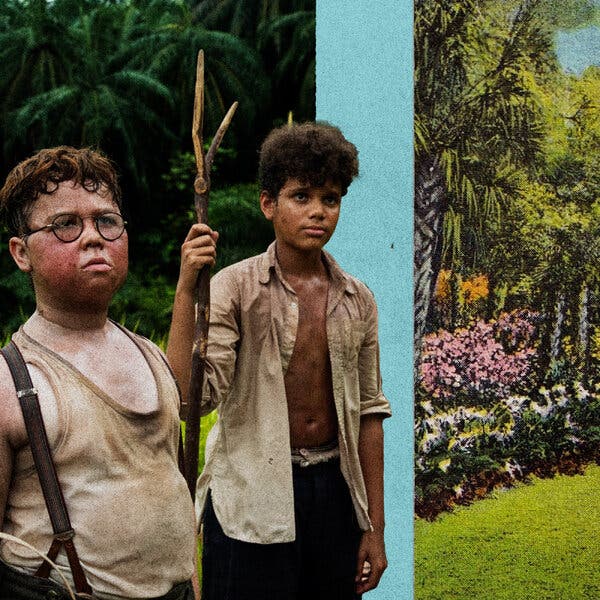
Back in my school days, William Golding’s “Lord of the Flies” was a must-read. While the novel remains on many shelves due to its Nobel status, its appeal has declined over the years.
Few 1950s novels have aged well in today’s busy, non-reading world. Golding’s bleak view of human nature felt relevant in 1954. Today, amidst school shootings and rising teen suicides, the struggles of Piggy and his peers seem outdated. They lack the intensity found in books like “The Chocolate War,” “The Hunger Games,” or Japanese works like “Battle Royale.” Human savagery doesn’t shock as it once did.
Into this world comes a new Netflix adaptation of “Lord of the Flies” by Jack Thorne. This prompts the question: does Golding’s story have anything left to convey?
Golding’s narrative stands on weak footing today, reduced to bare character elements. Its success inspired a proliferation of similar works across media. As writer Drew Basile notes, while Robinson Crusoe started the literary island trend, Piggy and Company birthed countless other darker islands. This saturation challenges the original’s ability to engage modern audiences.
Many haven’t read “Lord of the Flies,” yet its themes are intertwined with our cultural consciousness. The novel’s core ideas and primal imagery are pervasive, appearing in countless formats like graphic novels, video games, television series, and, naturally, other novels.
Stephen King’s works are filled with “Lord of the Flies” elements. His books like “The Long Walk” and his fictional town Castle Rock pay explicit homage. One can find traces of Golding’s influence in King’s “The Stand,” “Under the Dome,” “The Mist,” and “The Shining.”
Golding’s story has permeated diverse narratives and remains a significant cultural force, despite its decreasing direct readership.