
The FIFA World Cup trophy represents the pinnacle of accomplishment in soccer. Designed to embody three key sporting emotions, the trophy captures the athlete’s struggle, the fan’s jubilation, and the moment of victory.
Design and Origin
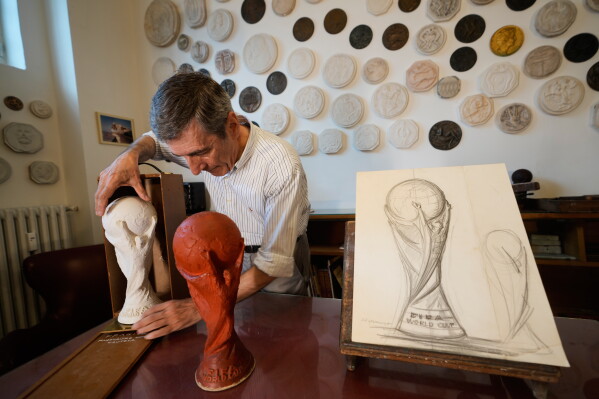
The trophy was conceived by Italian sculptor Silvio Gazzaniga in his studio in Milan’s Brera neighborhood. FIFA held an open competition for a new design after Brazil claimed ownership of the original trophy by achieving its third World Cup win in 1970. Gazzaniga’s design, familiar to soccer fans worldwide, features two figures spiraling toward an orb symbolizing the Earth.
Giorgio Gazzaniga, Silvio’s son, recalls his father’s creative process, saying “He sketched countless drawings before settling on the idea of merging the world and the symbolism of two DNA spirals ascending.” Silvio, celebrated for creating renowned trophies like the UEFA Cup and European Super-Cup, passed away in 2016.
History of the Jules Rimet Trophy
The original World Cup trophy, introduced in 1930, depicted the Greek goddess Nike and was named the Jules Rimet Trophy, honoring the tournament’s founder. After Brazil secured permanent possession upon winning three World Cups, FIFA commissioned a new trophy. The Jules Rimet Trophy was infamously stolen twice. First in 1966 in England, later recovered under a hedge by a dog named Pickles. Then again from Brazil’s Football Confederation in 1983, never to be found, and believed melted down.
Gazzaniga’s Vision
Silvio Gazzaniga’s design stood out among over 50 submissions because it conveyed a compelling narrative within its form, his son noted. “The trophy places the world atop, illustrating the athlete’s exertion and movement within the metal, symbolizing struggle for victory,” Giorgio explained. The victory is portrayed through arms resembling Victory wings, capturing not only the athlete’s triumph but also the fan’s delight.
Gazzaniga’s family has maintained his office, now in a new Milan location, preserving drawings, prototypes, and a wax cast of the original.
The Trophy’s Legacy
The World Cup trophy, 36 centimeters tall and crafted from 18-carat gold, sits on a base with rings of green malachite representing playing fields. Winners receive a gold-plated replica while FIFA retains the original at its Swiss headquarters between tournaments. Since then, FIFA no longer allows teams to keep the original if they win three times.
Having been in use for 14 World Cups, the trophy will continue at least until the 2038 tournament, according to Gazzaniga’s website. Giorgio recalls the 1974 final at home, when his father’s creation was first awarded. “Seeing the German team raise the cup in Munich, amidst overwhelming celebration, marked the moment when an object became an icon,” he stated.