
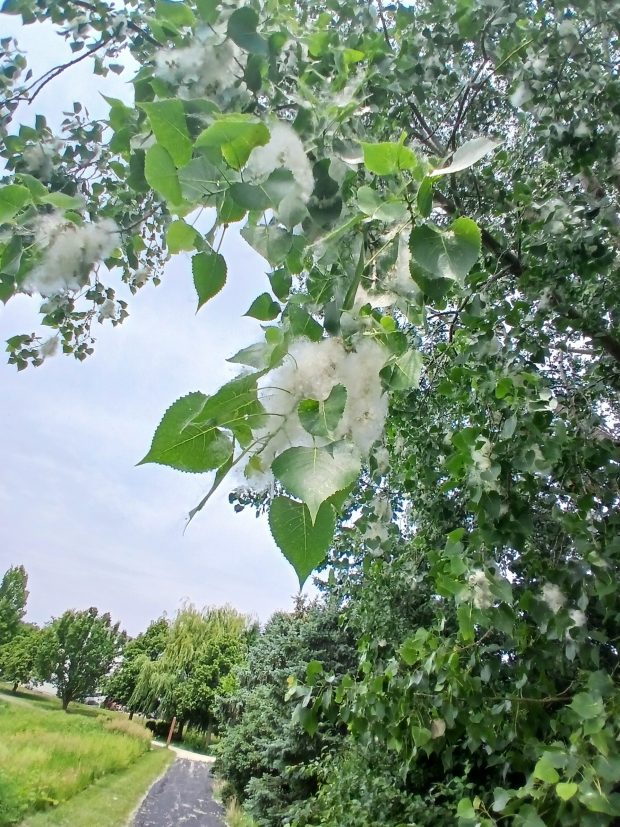
As a child, you might have noticed cotton-like fluffs soaring through the air in June. These are seeds of the eastern cottonwood tree. To a child, it can seem like snow falling in summer. Often, they gather along sidewalks, resembling large snowdrifts.
Recently, I revisited this phenomenon, trying to catch the ‘snow’ as it fell. I explored two Lake County forest preserves to find more eastern cottonwoods. These trees are recognizable by their elongated, triangular leaves, measuring 3 to 7 inches, with tiny rounded edges and a pointed tip.
The eastern cottonwood, part of the poplar family, grows fast and can reach heights of 100 feet. Some live over a century. Illinois hosts one of the tallest specimens at 122 feet, likely 200 years old, in Ogle County. Another variant, the swamp cottonwood, is found in southern Illinois, but it is smaller.
Cottonwoods thrive near water, with their young trees showcasing green-gray bark; mature trees have furrowed, gray bark. Like quaking aspens, the leaves flutter quickly in the wind because of their long stems. They bear seeds only after about ten years, with optimal seed production starting at thirty years. Only female trees produce the cotton. In spring, flowers called catkins form; male catkins release pollen, which the wind carries to pollinate female flowers. The seeds mature attached to white hairs called pappi, allowing them to travel far.
For many, including Bill Richmond from Palatine, the floating seeds signal the end of the school year and the start of summer in northeastern Illinois. Others dislike the mess or the sneezing they think it causes. Botanists explain that cottonwood fluff does not trigger allergies; if you’re sneezing, it might be due to other tree pollens like oak.
Cottonwoods can cause trouble. Their large roots disrupt septic systems and pipes. Brittle branches can break during storms, posing risks in residential areas. Therefore, some places, like Glencoe, prohibit planting them on public properties. Glenview lists them as less desirable compared to other native trees. Lake County Forest Preserves sometimes remove aggressive cottonwoods to promote diverse ecosystems.
Historically, Native Americans used cottonwood bark for food and medicine, and roots for creating ceremonial items. Today, the bark serves purposes like pulpwood and making wooden utensils. In nature, Baltimore orioles and great blue herons nest on cottonwoods, while bald eagles have raised young in them in Chicago. Other creatures, like rose-breasted grosbeaks and beavers, utilize the tree’s resources.
The roots of cottonwood help prevent streambank erosion, highlighting their ecological importance. Places like the Des Plaines River at Ryerson, Wright, and Half Day Woods host these remarkable trees. They hold value comparable to the revered oaks.
Sheryl DeVore has extensive experience as a writer and photographer for the Chicago Tribune. She is the author of several nature books and co-authoring a book about Midwest birds. Share your stories or thoughts with her at [email protected].