
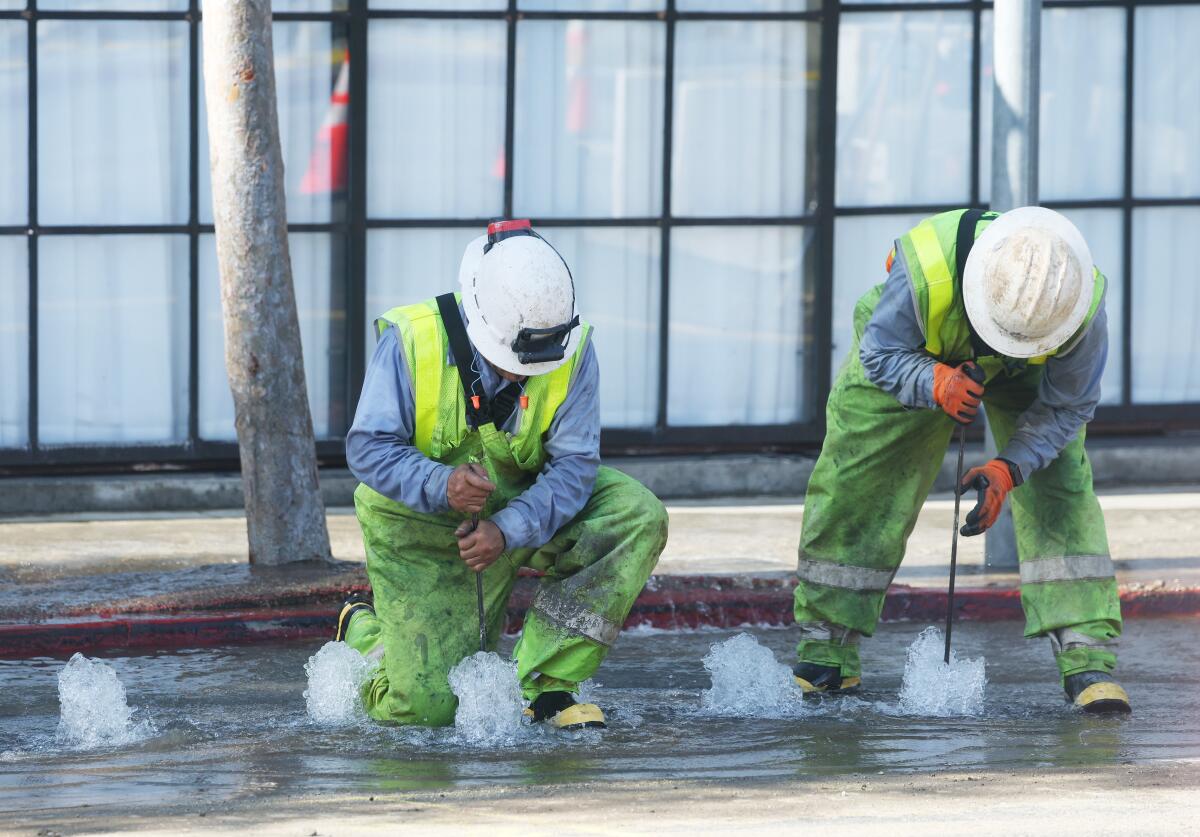
Los Angeles depends heavily on an expansive network of underground pipes, supplying over 400 million gallons of water daily to residents. This vast system, maintained by the Los Angeles Department of Water and Power (LADWP), often goes unnoticed until a significant failure occurs. A major incident happened on the morning of July 17 beneath Sunset Boulevard in West Hollywood. A 36-inch water main broke, creating a sinkhole and releasing 17 million gallons of water into the streets.
The pipe responsible for this disaster had been in service for 110 years. This highlights the city’s reliance on an infrastructure that, while essential, is aging rapidly. President Woodrow Wilson had just been re-elected when this pipe was installed, marking the passage of time alongside Los Angeles’ growth from a city of 500,000 to a bustling metropolis of 4 million.
Recent disturbances also affected local businesses, such as Dialog, where waterlogged tiles crumbled under inspection. Tadeh Ghazalian, owner of Dialog, expressed uncertainty about when operations could resume, labeling the incident as catastrophic.
The LADWP oversees approximately 6,800 miles of pipes with diameters ranging from 4 to 20 inches, alongside 570 miles of larger trunk pipes. Many function effectively until failure occurs, and the agency replaces them with newer models expected to last up to 150 years.
The department reports that 30% of its underground mainlines are 80 years old or more, compared to roughly 3.7% of L.A. County’s population. Despite this, older pipes can sometimes outperform their younger counterparts. Lucio Soibelman, a USC engineering professor, noted, “You can look at a 100-year-old pipe, and the pipe is in perfect condition.” He identified factors including soil compaction and water table levels as challenges to structural integrity.
LADWP’s recent efforts include replacing about 45 miles of deteriorating water lines annually. This new pace is about three times higher than two decades ago, yet increasing it further would require expanded manpower, more street closures, and higher costs to ratepayers, explained Anselmo Collins, LADWP’s water systems chief. In comparison, cities like Philadelphia and Boston face more frequent water main failures, and Los Angeles remains below the national average for leakages.
A quick study of Cambridge reveals a similar struggle with aging pipes. However, their five-year project aims to replace approximately 150 miles of pipelines, with some over 170 years old. Since early June, the city has experienced four water main breaks.
The burden of aging infrastructure stretches beyond pipes to include sidewalks and tree maintenance. It’s an expensive venture, and neglecting these systems increases the financial burden over time.
Reflecting on the city’s past, the pipe laid in 1916 saw a different Los Angeles, one of horse-drawn wagons and burgeoning trolleys. Iconic establishments like Philippe the Original were already serving Angelenos, while future landmarks were yet to come.
Amid these challenges, some symbols of endurance remain. The Bullwinkle statue at Sunset and Holloway endured the recent flooding, standing firm as a marker of resilience and continuity through the city’s evolution.