
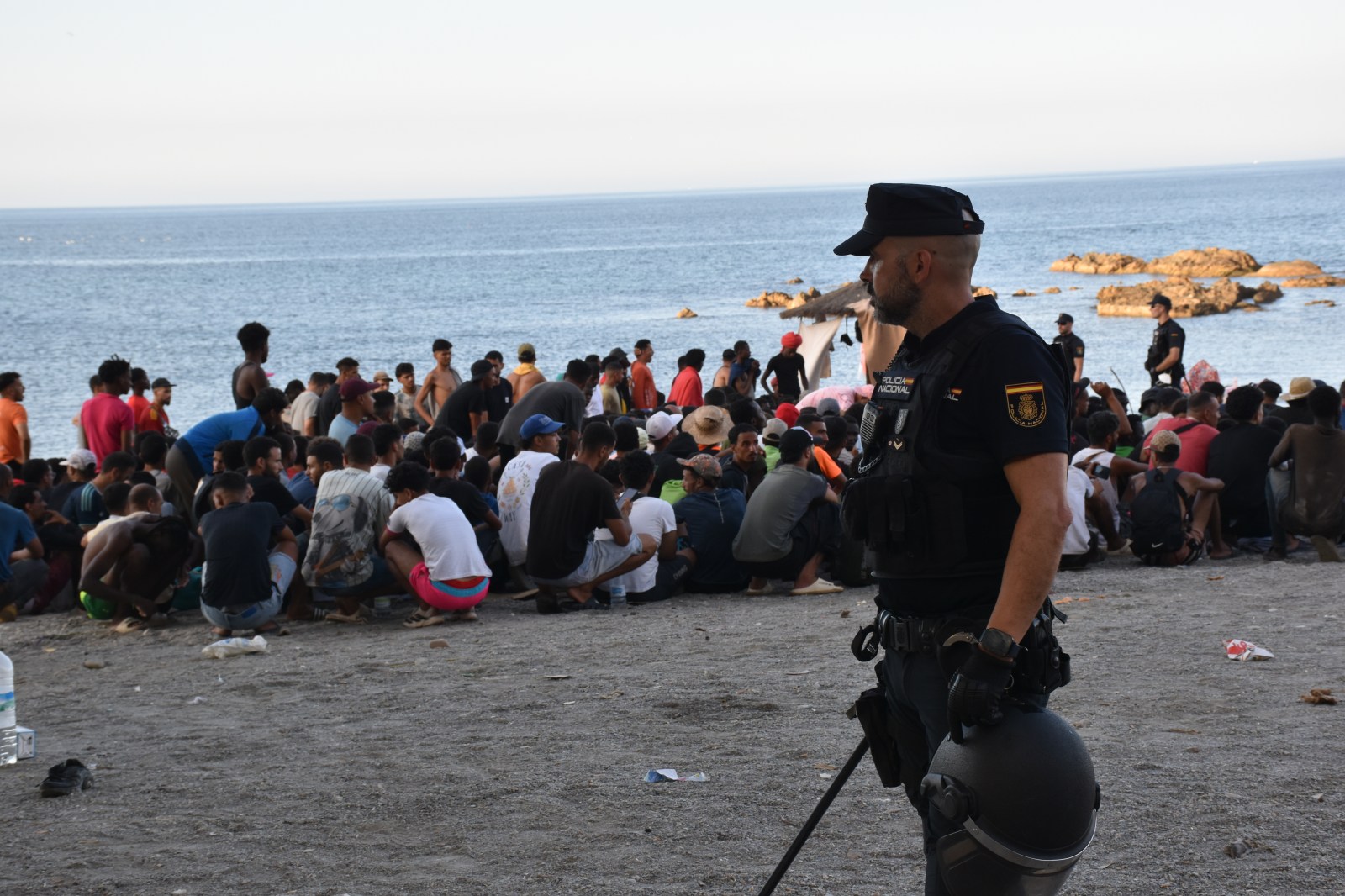
Spain’s foreign minister, José Manuel Albares, has vowed to return “every last person” who arrived in the city of Ceuta at the end of July to their country of origin. The surge of migrants has significantly impacted the city and Spain’s diplomatic ties with neighboring countries.
Approximately 72,000 individuals inundated the autonomous city between July 30 and 31. This influx led the Spanish government to send additional police and military units to Ceuta. Tragically, at least 80 people died during their attempt to enter the territory, with many trying to swim around the border fence or enter by land. Ceuta is an enclave in northern Africa, adjacent to Morocco, and its population stands at around 84,000.
In a statement from Ceuta, Albares announced the intention to return those who entered illegally to Morocco, with which Spain is cooperating. He met with Juan Jesús Vivas, the conservative leader of Ceuta, who noted that up to 11,000 of those who arrived in July are still in the city. The Spanish government reported that most were sent back to Morocco by early August, leaving around 2,000 migrants in Ceuta.
For those fleeing conflict or facing persecution, Spain offers an asylum application process. Unaccompanied children are given a hearing to assess their home circumstances, as reported by Spanish media outlets.
Vivas previously informed European legislators that the massive entry of migrants was akin to an “invasion” and urged the swift expulsion of anyone arriving unlawfully. Ceuta is one of the two European Union land borders with Africa, and it sometimes experiences migrant waves from individuals seeking to reach Europe. The other Spanish territory bordering Africa is Melilla.
Spanish Prime Minister Pedro Sánchez condemned the migration as “a violation and attack of Spain’s territorial integrity” primarily facilitated by human trafficking rings. “Trafficking mafias took a self-serving interpretation of a Supreme Court ruling,” he remarked.
Viral social media content falsely suggested the border into Ceuta was open for passage. Misleading information regarding a recent Spanish Supreme Court decision further contributed to the influx. The ruling, issued in late June, prohibited the immediate return of migrants arriving by sea into Ceuta and Melilla without a proper legal process.
The situation also strained Spain’s relations with Italy. Following the migrant influx, Italy started checking Spanish travelers in August. Spain responded with spot checks on Italian visitors, actions that Italy labeled as “incomprehensible and completely unacceptable.” Italian Prime Minister Giorgia Meloni’s government maintains a strict anti-immigration stance, earning praise from U.S. President Donald Trump earlier in the year.
Spain’s government, more favorable towards migration, criticized several European nations for their “polarizing” and “selfish” responses to the crisis. Sánchez accused fellow European leaders of spreading “fake news” regarding the situation.
Spain’s participation in the European Union and the Schengen Area allows for the abolition of passport and border checks among member countries, yet these rules do not extend to Ceuta. “Do not risk your lives, your money, and your future on a venture set for failure,” Albares emphasized on Tuesday.
For questions about this story, reach out to Newsweek editors John Fitzpatrick and Dave Siminoff.