
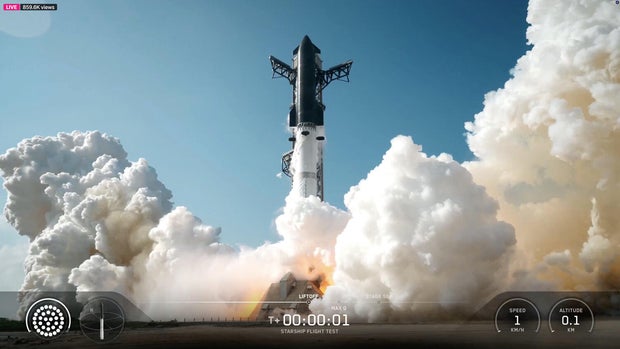
SpaceX successfully launched the enhanced Super Heavy-Starship rocket on Friday. This flight tested more robust engines, advanced control systems, and other critical upgrades to refine operations and enhance safety.
During ascent, one of the Super Heavy’s initial stage engines ceased function early. Additionally, several engines faltered during its attempt to return to its splashdown site near the Texas Gulf Coast.
The launch took place at SpaceX’s Starbase facility, marking the debut flight of the upgraded world’s most powerful rocket. The Starship upper stage, equipped with six third-generation Raptor engines, experienced an early shutdown of one engine optimized for vacuum operation. To compensate, the flight computer extended the run of the remaining engines, ensuring the spacecraft followed a suitable sub-orbital trajectory.
The reason for the premature engine shutdowns remains unclear. However, once in space, the Starship deployed 22 Starlink satellite simulators successfully. Two simulators featured cameras providing images of the Starship.
“On an epic first Starship V3 launch & landing! You scored a goal for humanity,” Elon Musk stated.
This mammoth rocket is central to SpaceX’s plans for deploying batches of Starlink satellites and various payloads for government and commercial entities, with future missions aimed at the moon and Mars.
Following the separation from the Starship upper stage, several engines of the Super Heavy booster failed to fire, hindering its course correction and causing it to miss the targeted splashdown point.
NASA Administrator Jared Isaacman observed the launch. The event took place on a newly fortified pad after resolving a launch pad system glitch and two weather delays. The 33 methane-fueled Raptor engines gave the rocket an impressive lift-off power, double that of NASA’s SLS moon rocket.
Isaacman tweeted:
“A hell of a V3 Starship launch. One step closer to the Moon…one step closer to Mars.”
The Version 3 Super Heavy-Starship launch involves testing new structural limits and maneuvers crucial for future operational launches. The Starship overcame the intense re-entry heat with remarkable integrity, demonstrating improvement over previous flights.
This test flight marks another step toward achieving goals such as piloted missions and deploying lunar surface bases. SpaceX’s Starship upper stage is engineered to become a lander for carrying Artemis astronauts starting in 2028. NASA’s next Artemis mission in 2027 plans to connect the Orion capsule with both SpaceX and Blue Origin’s landers in Earth orbit.
An artist’s impression by NASA and SpaceX shows the moon lander aspect of the project. Preparations are underway for unmanned moon landing missions to ensure readiness for astronaut landings by 2028.
A significant milestone is the autonomous refueling capability in Earth orbit, essential for deep space missions. The version 3 Starship includes features needed for these refueling tasks, and SpaceX gears up for orbital refueling tests planned within the year.