
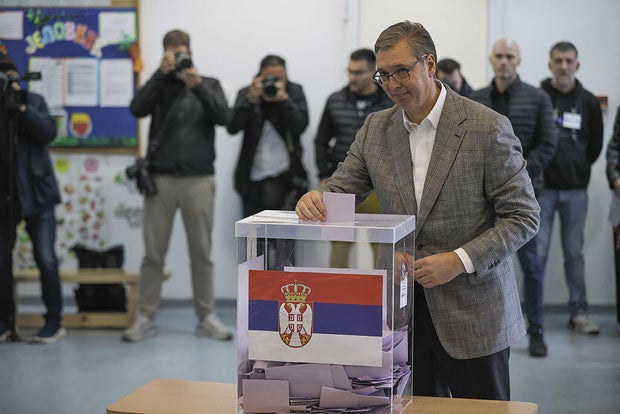
The long-standing leader of Serbia, Aleksandar Vucic, acknowledged his electoral defeat on Sunday. This election saw his right-wing party challenged by a diverse, student-led opposition movement. The students had spent two years protesting against his governance, marking a significant political change in the Balkan country.
Vucic, who had held near-absolute power for 14 years and had been backed by Russian President Vladimir Putin, faced accusations from students of corruption and anti-democratic practices. His critics also described the student movement as fueled by foreign influences. The election, characterized by high voter turnout and rising tensions, became a decisive contest between Vucic’s Serbian Progressive Party and student protesters who had gained popularity nationwide.
In the latest parliamentary elections, Serbia’s 6.4 million voters were responsible for choosing lawmakers for the 250-member Parliament. Vucic admitted that projections showed the youth-backed Students’ List would secure between 135 and 140 seats, while his SNS party was estimated to obtain around 105 seats. At his party’s event, Vucic declared the Students’ List victorious, attributing the loss to independent media and alleged interference by unnamed European countries, as well as an ‘American deep state’.
Aleksandar Vucic casts his ballot in a Belgrade school on October 25, 2026. (Samir Jordamovic/Anadolu via Getty Images)
Vucic stated that his party received approximately 1.7 million votes, whereas the Students’ List gained about 2.2 million. Following this announcement, Students’ List supporters filled the streets of Belgrade and other cities in celebration, chanting and honking car horns.
The election results came shortly after the polls closed, following a day of building tensions. Police in anti-riot gear secured areas in central Belgrade, particularly around the election commission’s headquarters. Special police vehicles were visible near locations where Vucic’s loyalists had camped for over a year, and large groups of men in black attire gathered throughout the city.
Vucic was campaigning to become Serbia’s prime minister after resigning as president the previous month. His popularity declined after a 2024 incident in Novi Sad, where a train station’s concrete canopy collapse killed 16 people. This event sparked youth protests blaming the disaster on high-level corruption and cronyism within the renovation project.
Despite these challenges, Vucic maintained support among many Serbian voters, who viewed him as a capable leader navigating global uncertainties. This image was bolstered by the mainstream media. However, the leaderless youth movement emerged as a formidable opponent, challenging Vucic’s control over Serbia more than any previous opposition efforts during his 14-year tenure.
The Students’ List, formed by university students, fielded candidates who were mostly unknown experts, athletes, farmers, and artists. None of the university students appeared on the election list. This strategy aimed to dismantle Vucic’s one-man rule and promote community solidarity. The student campaign focused on a bipartisan effort to revitalize Serbia’s economy and democracy. They traveled throughout the country, including rural areas, by cycling and walking to engage with disillusioned voters.
This victory mirrors recent electoral outcomes, such as the defeat of a Vucic ally in Hungary, where youth participation led to the removal of Viktor Orbán after 16 years and ushered in a new pro-European government. The Serbian election result could send ripples across Europe, where youth protests remain a growing trend.
Observers anticipated an election turnout of approximately 70%, a level not seen in Serbia since 2000. Long lines were observed at polling stations in Serbia and among the global Serbian diaspora. Some diaspora members had to vote during inconvenient hours due to synchronized voting times with Serbia.
Serbian elections have faced past accusations of irregularities, prompting the EU to monitor Sunday’s vote closely, as Serbia is a candidate for bloc membership. Independent monitors reported various irregularities like ballot photographing, suggesting voter pressure and attempted vote-buying. Concerns about election safety and fairness arose from detentions, government media control, and reports of surveillance and cyberattacks targeting activists.
Instances of journalist and activist attacks marked local elections in Serbia earlier this year. The 2023 parliamentary vote also led to opposition protests alleging election fraud.