
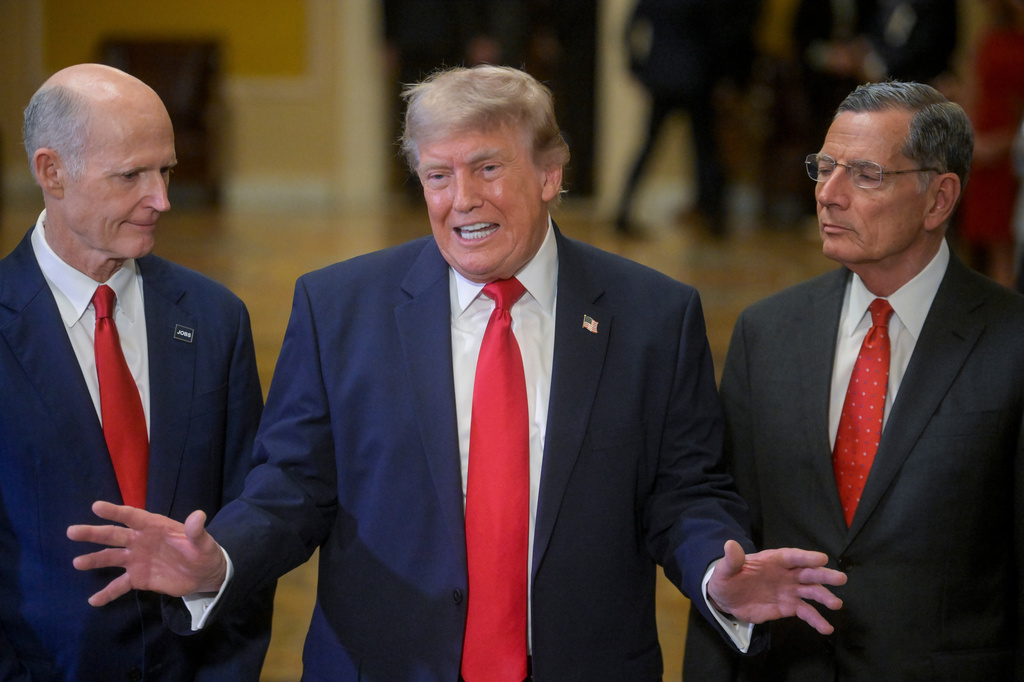
President Donald Trump recently attended a closed Senate Republican lunch, where he criticized four GOP senators for supporting a House resolution. This resolution aimed to prevent any future U.S. military action against Iran. The Senate had passed the resolution with a close vote of 50-48, which led to heated exchanges.
Senator Bill Cassidy from Louisiana, who had recently lost his primary to a Trump-supported candidate, confronted the president during the lunch. Cassidy challenged the administration’s lack of transparency and its extended military engagement in Iran. The ensuing argument highlighted the tension between Congress and the president regarding military decisions.
The administration argues that the resolution contradicts the Constitution based on a 1983 Supreme Court decision. In that case, the court deemed a one-house legislative veto unconstitutional, influencing numerous laws with similar provisions. However, the 1973 War Powers Resolution, which uses a two-house approach to end military hostilities, remains unchanged due to the court’s reluctance to address foreign policy disputes.
Senator Tim Kaine, encouraged by the recent vote, introduced a new resolution requiring presidential approval to limit military action in Iran. Still, the Senate vote fell short, with Cassidy opposing and Senator Rand Paul abstaining, resulting in a failed vote of 47-50.
At the same time, the Senate was caught in a legislative standoff over the president’s demands. Trump sought immediate action on the SAVE America Act in exchange for considering a housing bill. This conflict led to an early Senate adjournment amid tension over agenda control.
Additionally, the president disrupted the confirmation process for Jay Clayton, his nominee for director of national intelligence. Trump’s insistence on first confirming a successor for the district court attorney position complicated Senate schedules.
This strategy of leveraging nominations and bills has strained relations with Congress. The situation recalls “The Man Who Came to Dinner,” reflecting the president’s influence over congressional schedules and decisions, which poses challenges for lawmakers.
Don Wolfensberger, a former congressional staff member, sheds light on these dynamics. He has authored books on congressional culture, highlighting shifts from cooperative to power-driven politics.