
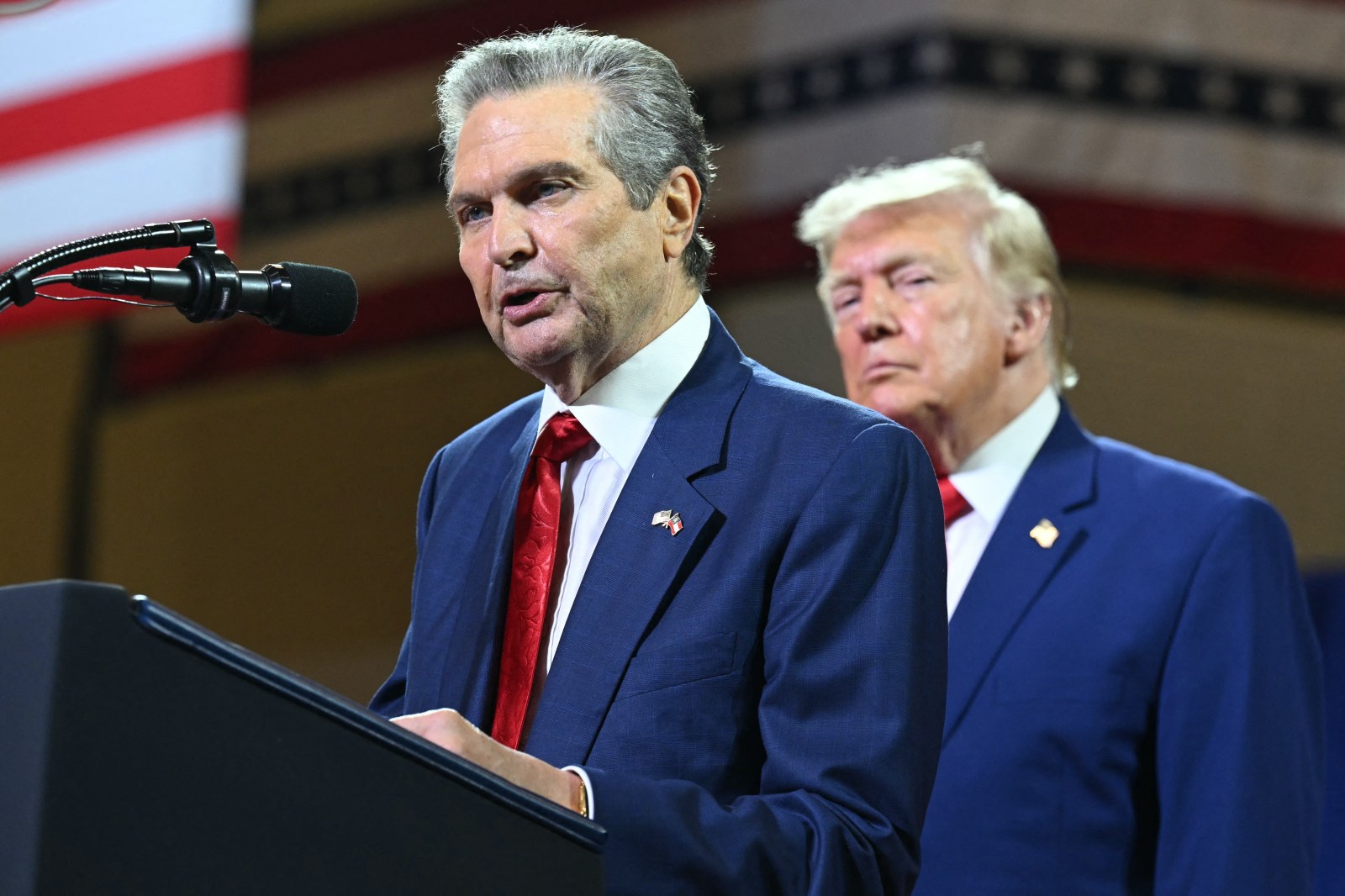
A Republican candidate for governor in Georgia, Rick Jackson, has committed to boosting the state’s support for President Donald Trump’s recent investment initiative for children. He pledges to provide an additional $1,000 to “Trump Accounts” if elected. Jackson stated he would personally cover the expense if the state legislature doesn’t approve the funding.
Jackson made this announcement while attending a rally with Trump in Marietta, Georgia. The president promoted the new federally supported savings accounts as part of his campaign for Republican candidates. Georgia is recognized as a politically competitive state, with approaching Senate and gubernatorial elections attracting nationwide attention.
Jackson addressed his supporters at Wheeler High School, declaring his intention to have Georgia match the federal government’s initial contribution to each qualifying child’s Trump Account. “When I become governor, the state of Georgia will match the federal contribution with another $1,000. If the legislature doesn’t agree, I will personally fund it,” he vowed.
Jackson linked his promise to his childhood experiences, recounting how a generous act changed his life. “More than 50 years ago, an anonymous person left $100 for a lonely boy. That gift helped me believe in a brighter future. Now, with help from President Trump and First Lady Melania Trump, we offer this hope to children in Georgia.”
On the other side, Democratic candidate Keisha Lance Bottoms criticized Jackson’s alignment with Trump. She argued that the campaign should address state concerns rather than Trump’s agenda, especially as Georgians are concerned about economic conditions and living costs.
Jackson is the founder of Jackson Healthcare, a successful medical staffing firm. Forbes estimates his net worth at around $1 billion. His upbringing involved overcoming early hardships. His father left when he was an infant, and his mother, who struggled with alcoholism, raised him with a sixth-grade education. Jackson grew up in public housing in Techwood Homes, near Georgia Tech, where he earned money selling newspapers and tickets.
Trump visited Georgia to promote the new investment accounts and back Republican Representative Mike Collins for the U.S. Senate and Jackson for governor. Protesters assembled outside the rally, opposing Trump’s policies and visit, highlighting Georgia’s intense political divide.
Understanding Trump Accounts
Trump Accounts, introduced on July 4, serve as tax-advantaged investment programs for minors. Each child born in the U.S. between 2025 and 2028 gets a $1,000 federal contribution. Additional contributions of up to $5,000 are allowed yearly from parents, relatives, friends, and employers.
Until the child reaches 18, the account is managed by a parent or guardian. On reaching 18, the individual gains control of the account, which can be used for education, home buying, or business startups. Without annual contributions, the account growth projection is approximately $6,000 by age 18. With a $250 yearly addition, it reaches about $19,000; the maximum yearly addition would expand it to around $271,000.
At the rally, Trump praised the accounts as a financial stepping stone for young Americans. “Washington politicians left nothing but debt for our children. With Trump Accounts, we ensure each young American has a fair start toward their dream.” Treasury Secretary Scott Bessent hailed the initiative as a “triumph of capitalism over socialism.” Education Secretary Linda McMahon noted that the program would widen opportunities, enabling pursuit of the American dream.
Cost Implications of Trump Accounts
The Committee for a Responsible Federal Budget estimates the $1,000 federal contributions will amount to $17 billion through 2028. Georgia’s proposed $1,000 match would need legislative consent to proceed. Although Republicans control both legislative chambers, approval would require navigating budget considerations and potential financial scrutiny.
Jackson expressed confidence in obtaining legislative approval, though no bill has been introduced, nor have legislative leaders expressed public support. Should he win the governorship, Jackson must collaborate with lawmakers to draft a viable plan for state matching contributions. This plan could necessitate significant state investment, contingent on how many children qualify during the program’s operation. Jackson has yet to share specifics on financing or potential budgetary reallocations.
Contact Newsweek editors on this story: Daniel Orton and Cristina Diciu.