
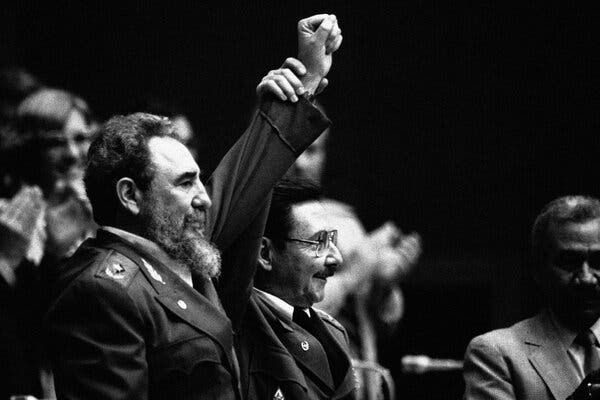
Raúl Castro, now 94, no longer holds an official position in Cuba. Despite this, experts believe he still exerts significant influence, especially over the military.
Raúl Castro served as Cuba’s defense minister for 49 years and as its president for 12 years, until stepping down in 2018 after Fidel Castro resigned due to illness. Cuban state media continue to honor him as “the leader of the Cuban Revolution,” recognizing his pivotal role alongside Fidel in the 1959 uprising against the U.S.-backed regime.
Though he faces health challenges such as frailty, hearing loss, and speech difficulties, Raúl Castro remains involved in major events. He appeared in his military uniform at a recent International Workers’ Day parade. Reports suggest that he is actively engaged in clandestine discussions with the Trump administration regarding Cuba-U.S. relations.
Raúl’s lifestyle once included heavy drinking, favoring vodka, a habit he developed during his studies in Moscow, admiring the Soviet Union. However, he appears to have aged well, as noted by his former chief of staff, Alcibiades Hidalgo, now living in Florida. Hidalgo observes that Raúl Castro continues to be an influential figure in determining Cuba’s path.
While Fidel Castro, who passed away in 2016, was known for his charismatic leadership, Raúl opted for a supportive role. According to Brian Latell, a former C.I.A. analyst on Cuba, Raúl focused on operational and background tasks, complementing Fidel’s leadership vision.
Raúl Castro played a crucial role in developing Cuba’s Revolutionary Armed Forces, successfully fending off the CIA-backed Bay of Pigs invasion. When Fidel proclaimed Cuba a Communist nation in 1961, Raúl was instrumental in organizing the Communist Party.
As defense minister, Raúl guided the formation of GAESA, a military conglomerate that controls critical sectors such as hospitality, retail, and fuel, making it Cuba’s dominant economic entity.
Initially seen as a reformist, Raúl Castro relaxed strict economic policies, allowing property transactions and vehicle sales. In 2015, he renewed diplomatic ties with the United States and hosted President Obama in Havana the following year.
Nevertheless, Raúl Castro maintained the island’s strict political oversight and continued the operations of its repressive state security system.