
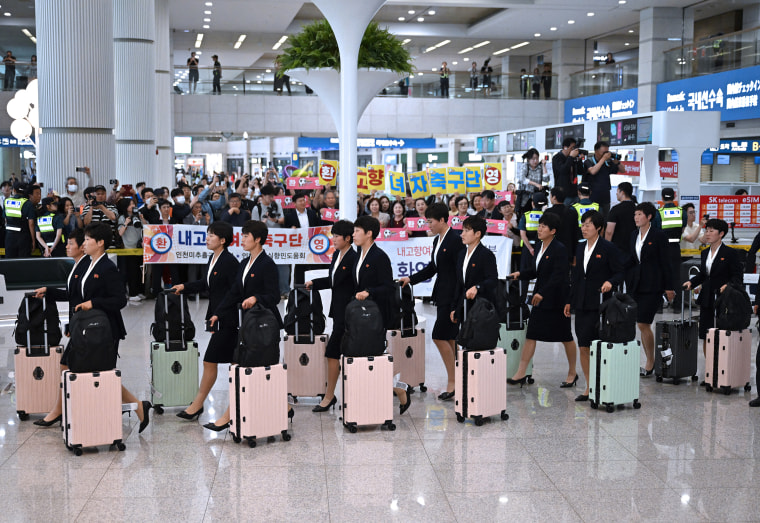
The North Korean women’s soccer team’s visit to South Korea marks a significant moment in sports and diplomacy. On Wednesday, they took the field in South Korea, representing the first sports team from the North to visit in nearly eight years. This event has garnered immense interest, showcasing both the athletic prowess and diplomatic efforts of North Korea, a nation still technically at war with the South.
North Korea’s leader, Kim Jong Un, has adopted a more confrontational stance towards South Korea, considering it a ‘primary foe.’ The North has rejected numerous dialogue attempts from South Korea’s President Lee Jae Myung. Despite these tensions, the focus remained primarily on sports during the North Korean visit.
The match, according to Ri Yu Il, coach of Pyongyang’s Naegohyang Women’s FC, was strictly about sports. His team defeated South Korea’s Suwon FC Women 2-1 in the Asian Football Confederation Women’s Champions League semifinals.
The North Korean team’s victory advances them to the finals, where they will face Japan’s Tokyo Verdy Beleza.
The interest in the North-South Korea game has been significant. All 7,087 general admission tickets sold out quickly. Among the spectators were around 3,000 supporters from civic groups backed by Seoul’s Unification Ministry, cheering for both teams. The groups emphasized supporting both sides to promote ‘fair play’ and ‘peace.’
Ri emphasized that the cheering squad was not his team’s focus; they were solely concentrating on the match. The North Korean delegation, comprising 27 players and 12 staff, traveled via Beijing before arriving in South Korea. Known for excelling in women’s soccer, North Korea often succeeds in youth competitions, surpassing the achievements of their men’s teams.
Analysts suggest North Korea might use this event to project stability and strength. Lim Eul-chul from Kyungnam University indicated that this match offers a chance for South Korea’s liberals to potentially enhance inter-Korean relations. Moreover, the athletes’ movement signals that minimal communication and security assurances between the Koreas remain operational.