
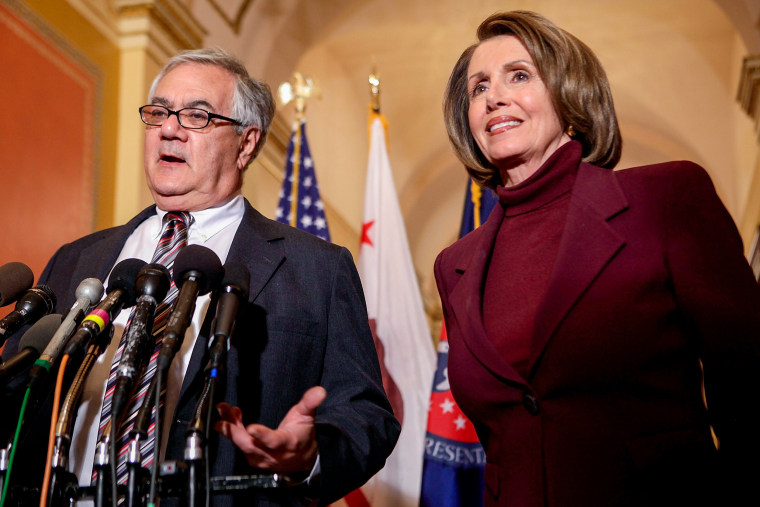
Barney Frank’s political career began when he left Harvard to become chief of staff for Democratic Boston Mayor Kevin White from 1968 to 1971, during a period of racial tension in the city. His next role was as a staff assistant for Rep. Michael F. Harrington, a Democrat representing Massachusetts’ 6th Congressional District.
In 1972, Frank entered electoral politics, securing a seat in the Massachusetts Legislature. He was re-elected three times while earning a J.D. from Harvard Law School. In 1980, he narrowly won a seat in the U.S. House, representing Massachusetts’ 4th Congressional District, with just under 52% of the vote. This initial tight race was not the norm; he won his next 15 re-elections easily and became a well-known liberal figure in Congress.
In 1987, during his fourth term, Frank came out as gay voluntarily, becoming the first member of Congress to do so. He stated, “If you ask the direct question: ‘Are you gay?’ the answer is yes,” affirming his openness about his identity.
“I’ve said all along that if I was asked by a reporter and I didn’t respond, it would look like I had something to hide, and I don’t think I have anything to hide. I don’t think my sex life is relevant to my job, but on the other hand, I don’t want to leave the impression that I’m embarrassed about my life.”
Frank faced a significant scandal in 1989 when news emerged about his relationship with a male sex worker, Steve Gobie, who was using Frank’s apartment as a base for prostitution. Frank acknowledged paying Gobie for sex but fired him upon learning of the misuse.
The House voted 408-18 to reprimand Frank in 1990 after the Ethics Committee found he had fixed Gobie’s parking tickets, yet an attempt to censure him failed. Despite this, Frank retained his constituents’ support and won re-election comfortably with 66% of the vote.
Throughout his three decades in the House, Frank championed a liberal agenda, advocating for abortion rights, environmental protections, anti-discrimination in employment and housing, and LGBTQ equality. He notably pushed for repealing “don’t ask, don’t tell,” a policy barring openly gay and bisexual people from serving in the military.
The Dodd–Frank Wall Street Reform and Consumer Protection Act stands as Frank’s most significant legislative achievement. It aimed to stabilize financial markets after the 2008 crisis, targeting the “too big to fail” Wall Street institutions. Signed into law by President Obama in July 2010, the act faced criticism from both progressives and conservatives.
Frank also drew scrutiny for his support of Fannie Mae and Freddie Mac, advocating for low-income customer mortgages, which some critics argue contributed to their near collapse and the housing crisis.
In 2010, Frank faced a strong challenge from Sean Bielat, a tea party candidate, ultimately winning with about 54% of the vote, and chose not to seek re-election in 2012. He was succeeded by Joe Kennedy III. In the same year, Frank married Jim Ready, remarking that married life offered him a pleasant experience despite little day-to-day change.
Three years later, Frank released an autobiography detailing his life from the Great Society to same-sex marriage advocacy. The Supreme Court legalized same-sex marriage nationwide in 2015, and Frank expressed his joy with the hashtag #lovewins.
Barney Frank is survived by Ready and Breay, along with siblings Ann Lewis and David Frank.