
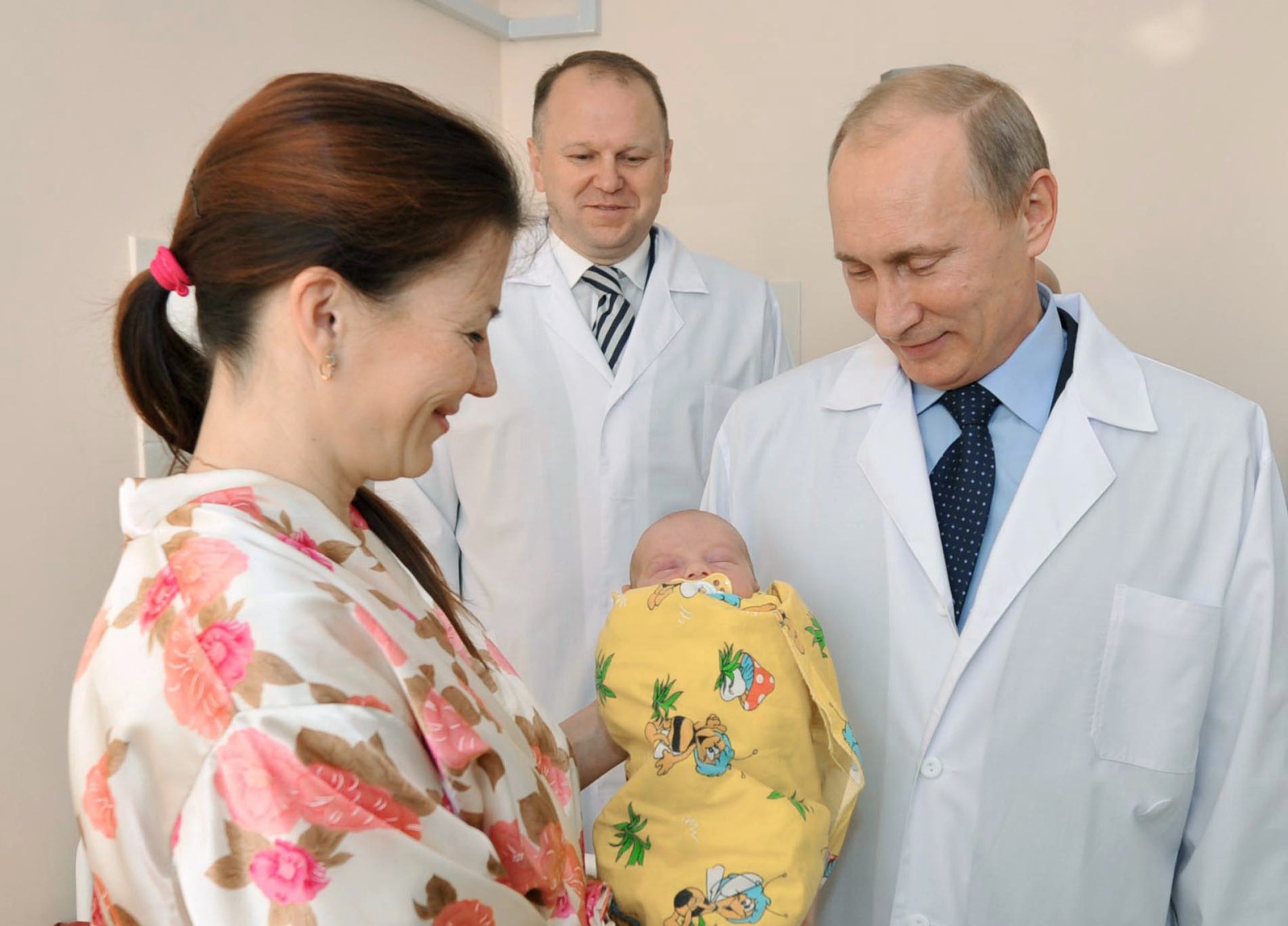
President Vladimir Putin is determined to encourage Russian women to have more children. While abortion remains legal in Russia, authorities are making efforts to limit access to the procedure. This includes banning child-free advocacy, pressuring clinics to cease abortion services, and imposing waiting periods and counseling for women seeking abortions.
Recently, Putin introduced a new initiative. On Monday, he instructed the government to develop strategies to ensure that search engines prioritize pregnancy support sites when users look for abortion services. This policy comes at a time when resources aimed at supporting women’s reproductive choices are being redirected toward military spending. Moscow has allocated over one-third of its federal budget to defense, while regional healthcare funding is declining and social benefits face delays.
Historical Context of Population Efforts
Putin’s focus on increasing birth rates reflects a long-standing Russian tradition. In 1944, Soviet leader Josef Stalin introduced the ‘Mother Heroine’ award for women who bore and raised at least ten children as the Soviet Union sought to recover from wartime losses. Putin revived this initiative in August 2022.
In September, speaking at the Eastern Economic Forum, Putin asserted that low fertility rates pose a national security threat. Despite the ongoing conflicts and challenges, the logic centers around demographic concerns. Although official fertility rates are no longer published, Deputy Prime Minister Tatyana Golikova disclosed a figure of 1.352, falling short of the replacement rate of 2.1. Researchers estimate that only around 1.19 million babies will be born in 2025, marking a post-Soviet low. Demographers predict that Russia’s population will decrease from 146 million in early 2025 to about 141 million by 2036.
Government Initiatives and Economic Challenges
The Russian government launched a national project called ‘Family’ in 2025. This integrates maternity grants, subsidized mortgages, and child benefits, offering eligible families approximately 729,000 rubles ($9,000) for housing, education, and related expenses for their first child, with additional support for a second child.
Simultaneously, authorities are undermining abortion access. Human Rights Watch reports that at least 25 Russian regions have imposed fines on organizations and individuals advocating for abortions. Private clinics face pressure to reduce services, and women must undergo mandatory waiting periods and counseling aimed at discouraging abortion.
Economic hardship is a major factor driving abortion decisions. In Vologda, an area known for anti-abortion policies, 59.8 percent of abortion-related decisions are linked to economic insecurity, such as low incomes, unemployment, debt, and housing issues.
Prioritizing Defense Over Social Spending
Russia’s draft 2027 budget allocates a massive 17.15 trillion rubles ($213 billion) to defense, equating to 35.2 percent of federal expenditure. In contrast, federal healthcare receives 1.82 trillion rubles ($22.6 billion or 3.7 percent). While the ‘Family’ project gets 5.9 percent of the budget, it falls 10 percent short of what was initially promised.
A report by Russia’s Accounts Chamber indicates that regional healthcare spending decreased by 5.8 percent in the first half of the year compared to 2025. Some regions are experiencing more significant reductions. For instance, in Primorsky Krai, legislators cut education spending by 644 million rubles and social support by 207 million rubles. Healthcare programs lost over a billion rubles, delaying many facility projects to the following year.
The regional labor ministry has acknowledged that wartime demands are straining budgets, leading to delayed social payments. However, resources for war-related assistance have increased, with a 1.5 billion ruble reallocation and an enhanced military recruitment bonus of 3 million rubles.
In his September speech, Putin maintained that demographic challenges are not solely wartime outcomes, citing even lower fertility rates in countries like Japan and South Korea. Although the crisis predates the ongoing conflict, the extensive allocation of resources to war, which has reportedly resulted in 1.4 million casualties among Russian men according to a report by the Center for Strategic and International Studies, is exacerbating the issue.
The Kremlin’s focus on influencing search results may be better directed towards fulfilling promised payments to families and reducing the wartime burden, rather than attempting to control reproductive choices.