
As the nation marks its 250th anniversary, one local connection to presidential history is the Kankakee River and its adjoining marshland. This area, which I cross daily via bridge, holds significant historical value. According to John Hodson, the Kankakee Valley Historical Society President, the section of the Kankakee River near Baums Bridge Road in Kouts is steeped in history from the mid-1700s to the 1930s.
The Collier Lodge, established in the late 1800s, is a remnant of the elite sportsmen lodges that once flourished here. Hodson, who acquired it in 2000, noted its deteriorated state. This lodge and Baums Road provided one of the few clear routes to the river, making the landscape valuable. Hodson and other historians, including my late father Chester, noted that the most significant change came when government efforts drained the Grand Kankakee Marsh. Over 500,000 acres of natural wetlands were lost to create farmland. This ecological alteration was soon recognized as a mistake.
Today, the Collier Lodge is the last standing structure from the ‘sportsmen era’ of 1880 to 1910. It was a time when 26th President Theodore Roosevelt and figures like General Lew Wallace and President Grover Cleveland frequented the Hoosier river for hunting and fishing.
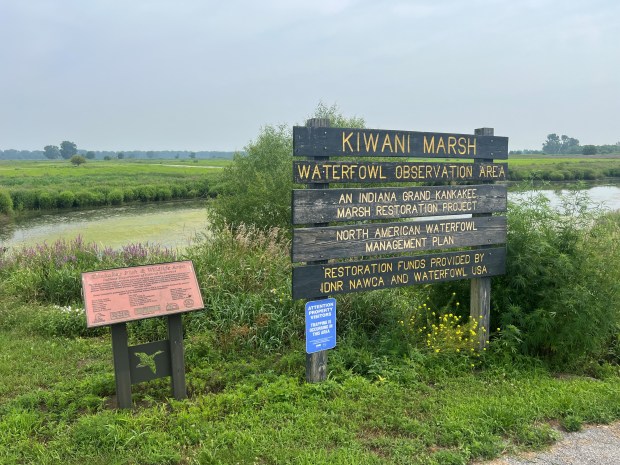
Recently, visiting my niece Bethany in North Judson, I took a route past the Kiwani Marsh. This area, part of a 125-mile revitalized wetland in Starke County, is managed by the Indiana Department of Natural Resources. It’s a result of a restoration project that began in 2010 and was dedicated in 2012. The marsh now serves as a vibrant habitat for wildlife, including teal, ducks, and geese. The area was historically a part of the Grand Kankakee Marsh before being drained and used for row cropping. Thanks to a collaboration with Ducks Unlimited, a nonprofit focused on wetlands protection, it has been restored to support diverse wildlife.
My older brother David named his son Quentin after President Teddy Roosevelt’s youngest son Quentin, who died in World War I. President Roosevelt, a robust man, was a keen hunter known for his hearty appetite. At one point, he weighed over 220 pounds at 5 feet 8 inches tall. He loved fried chicken with pan gravy, a dish he attributed to his mother’s cooking. His successor, President William Howard Taft, was known for his even greater size, reaching over 340 pounds, prompting the installation of a larger bathtub in the White House. President Taft served from 1909 to 1913 and passed away at 72 in 1930.
President Teddy Roosevelt’s Favorite Fried Chicken with Pan Gravy
Makes 4 servings
Ingredients:
- 4 boneless skinless chicken thighs (or bone-in pieces)
- Brine: 1 cup buttermilk, 1 egg, 1 1/2 teaspoons salt
- Coating: 1 1/2 cups all-purpose flour, 1/2 cup cornstarch, 1 teaspoon baking powder, 2 teaspoons paprika, 2 teaspoons garlic powder, 2 teaspoons onion powder, 2 teaspoons black pepper, 1 1/2 teaspoons salt
- Frying: 4 cups peanut oil
- Gravy: 2 tablespoons bacon fat (or butter), 2 tablespoons flour, 1 1/2 cups whole milk, 1 teaspoon white vinegar
Directions:
Brine the chicken by pounding the thighs to a half-inch thickness. In a bowl, whisk together the buttermilk, egg, and salt, then add the chicken and chill for at least 4 hours. Reserve the brine. For the coating, mix flour, cornstarch, baking powder, and spices in a large bowl. Stir a few spoonfuls of wet brine into the flour to form flaky bits. Dredge the chicken in the flour mixture, pressing it onto the meat. Heat peanut oil in a heavy skillet to 400 degrees and fry the chicken until golden brown and cooked through.
For the gravy, melt bacon fat or butter in a pan and whisk in flour for one minute. Slowly pour in the milk, simmer until thick, stir in vinegar, and season. Serve the fried chicken with the warm gravy.