
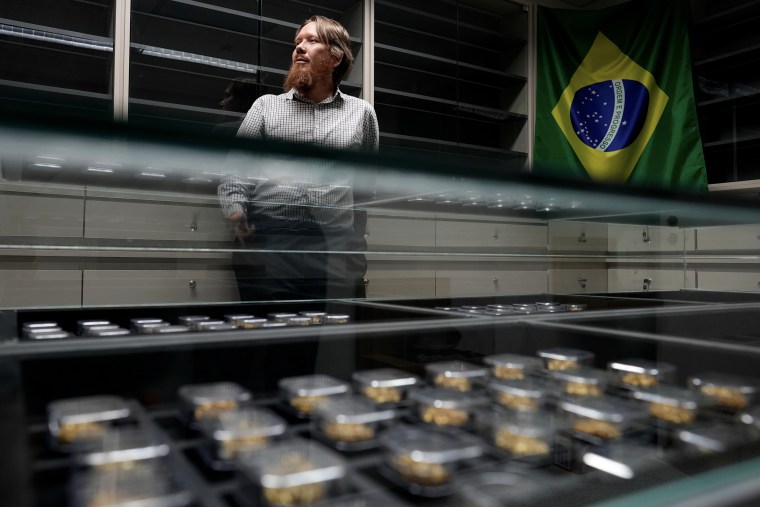
Brazil is employing forensic science to fight illegal gold mining in the Amazon. This activity threatens the rainforest, Indigenous groups, and other communities, accelerating deforestation and mercury contamination. The work is conducted at the National Institute of Criminalistics in Brasilia, where federal police have established a ‘gold lab’ for collecting and analyzing gold samples from across the country.
The goal is to identify the origin of newly acquired samples, such as gold seized in police raids, to determine if they originate from protected areas, indicating illegal mining. This process, known as ‘gold fingerprinting’, involves precise tracing of gold samples to pinpoint their origin.
Tackling Illegal Gold Mining through Forensic Analysis
The gold lab employs various techniques like X-ray fluorescence spectrometry, scanning electron microscopy, and laser ablation mass spectrometry. According to Gustavo Geiser, a federal police forensics expert, the method has been developed in collaboration with Brazilian universities since 2019. The complexity of forensic examinations has increased over time, but the central question remains: ‘Where did this gold come from?’
Identifying a gold sample as illegally mined aids police in building cases for further investigation and potential charges.
Legal Markets and Environmental Crime
Environmental criminals in the Amazon often resort to fraud to insert illegally mined gold into legal markets. Similar fraudulent activities occur with cattle and timber. The global rise in gold prices has heightened the mining rush in the Amazon rainforest.
Amazon Mining Watch estimates around 496,000 hectares of rainforest have been cleared for mining since 2023, including 223,000 hectares in the Brazilian Amazon.
Brazil’s Federal Court of Accounts indicated evidence of mining permits granted by the National Mining Agency being misused to sell gold extracted from protected areas. Greenpeace has reported how legal mine owners falsely declare gold extraction, while illegal operations thrive on adjoining Indigenous lands.
A recent order from a federal court in Para mandates institutions like the Central Bank and the National Mining Agency to implement strict control and traceability measures for gold from mines to markets. Prosecutor André Porreca highlighted mining permits being misused to launder gold from Indigenous territories and protected areas.
Geiser emphasizes that the gold lab in Brasilia plays a key role in combating crime and strengthens global gold supply chains, ensuring gold’s legitimacy for financial uses.
Mercury Contamination and International Cooperation
Brazil’s commitment to addressing illegal gold mining includes reducing mercury contamination. The Amazon plays a crucial part in global climate regulation, making its degradation a significant concern. According to MapBiomas, over 90% of Brazil’s mining occurs in the Amazon, with nearly 40% being illegal.
Though illegal mining contributes less to deforestation compared to agriculture, its environmental damage is difficult to reverse due to mercury usage. Mercury released into rivers contaminates water and fish, essential to Indigenous life. A Fiocruz study revealed that 21.3% of fish in Amazonian markets exceed WHO safety limits for mercury, affecting children’s health significantly.
Brazil has signed the Minamata Convention on Mercury, committing to eliminate mercury in gold mining. A draft by the Ministry of Mines and Energy aims to phase out mercury, pending debate until Aug. 7, with emphasis on consulting affected Indigenous groups.
Geiser notes that a total ban on mercury could enhance environmental protection and forensic investigations, clearly identifying illegal mining activities.