
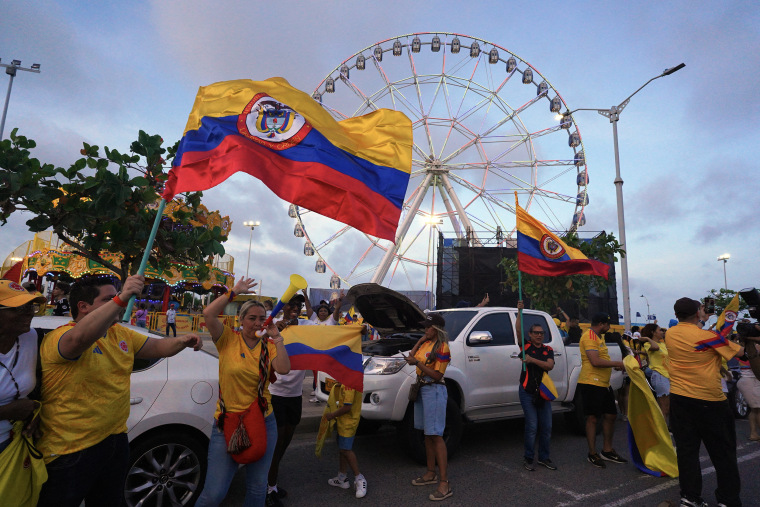
BOGOTÁ, Colombia – Abelardo de la Espriella, an outsider in Colombian politics, held a slight lead in the presidential elections. Nearly all the votes were counted on Sunday, marking a runoff characterized by concerns over a potential resurgence of internal conflict. His victory would signal a rejection of the policies of outgoing President Gustavo Petro, whose ally had pledged to continue his agenda if victorious.
A lawyer and business owner, de la Espriella, who received an endorsement from former U.S. President Donald Trump, led the way with 49.7% of the votes against progressive lawmaker Iván Cepeda, who received 48.7%. This data came from electoral authorities, although they have not formally declared a winner.
“I appear before you tonight to announce the most important news of my life: The Colombian people have entrusted me with the supreme honor of serving them as their next president of the Republic of Colombia,” de la Espriella declared to thousands gathered in Barranquilla.
Despite the announcement, Cepeda considered the count unofficial and planned to challenge results from over 30,000 voting stations. No recount has overturned a presidential election result in Colombia.
“We will not allow … the rollback of the social gains we have achieved,” Cepeda maintained.
Outgoing President Petro also expressed intentions to contest the results. The streets of Bogotá resonated with chants of “Petro out!” and celebrations ensued.
Both candidates proposed starkly different strategies to prevent the recurrence of widespread violence that marred previous decades in Colombia. The election’s victor will commence a four-year term starting August 7.
Approach to Crime and Security
At 47, de la Espriella promised a hardline stance on crime, especially drug trafficking. He aims to halt Petro’s attempts at peace negotiations with various armed factions, which have largely been unsuccessful, and plans to establish megaprisons, drawing from Salvadoran President Nayib Bukele’s policies. These methods led to reduced homicide rates in Central America but sparked human rights abuse allegations.
De la Espriella, who holds dual citizenship in Colombia and the U.S., is a known Trump supporter and Republican Party member.
“We have had an armed conflict and a drug trafficking problem for too long, and this has greatly polarized the country,” commented retired economist Víctor Duque.
Political leaders such as U.S. Secretary of State Marco Rubio and Presidents Javier Milei (Argentina) and Daniel Noboa (Ecuador) were quick to congratulate de la Espriella.
The Trump Administration anticipates close collaboration with Colombia to enhance regional security and strengthen bilateral economic relations.
Doubts and Challenges
In the initial voting round, Cepeda garnered 41% while de la Espriella had 44%, according to official statistics. Despite leading polls prior to May, Petro expressed doubts over the results.
Yolanda Hernández, 49, switched her political allegiance from Petro in 2022 to de la Espriella. Although Petro could not fulfill promises of benefiting the poor due to congressional roadblocks, she asserted that the status quo must change.
“We want change…always the same violence, always the same thing,” Hernández shared.
Regional Divisions and Violence
Will Freeman from the Council on Foreign Relations observed the election outcome reveals a lack of decisive shift against Petro or an overarching acceptance of de la Espriella’s firm approach.
The election occurs a decade after Colombia signed a peace agreement with FARC rebels. Yet, violence resurged, with former rebel groups transitioning from ideological struggles to drug trafficking. Colombia currently has over 27,000 members across illegal factions.
The past year saw 14,780 homicides—the most recorded since 2015, stemming from conflicts among illegal armed factions. The country also experienced a rise in extortion cases, illustrating ongoing turmoil.
De la Espriella, dubbed “The Tiger,” pledged to tackle criminal activities agressively by establishing ten megaprisons.