
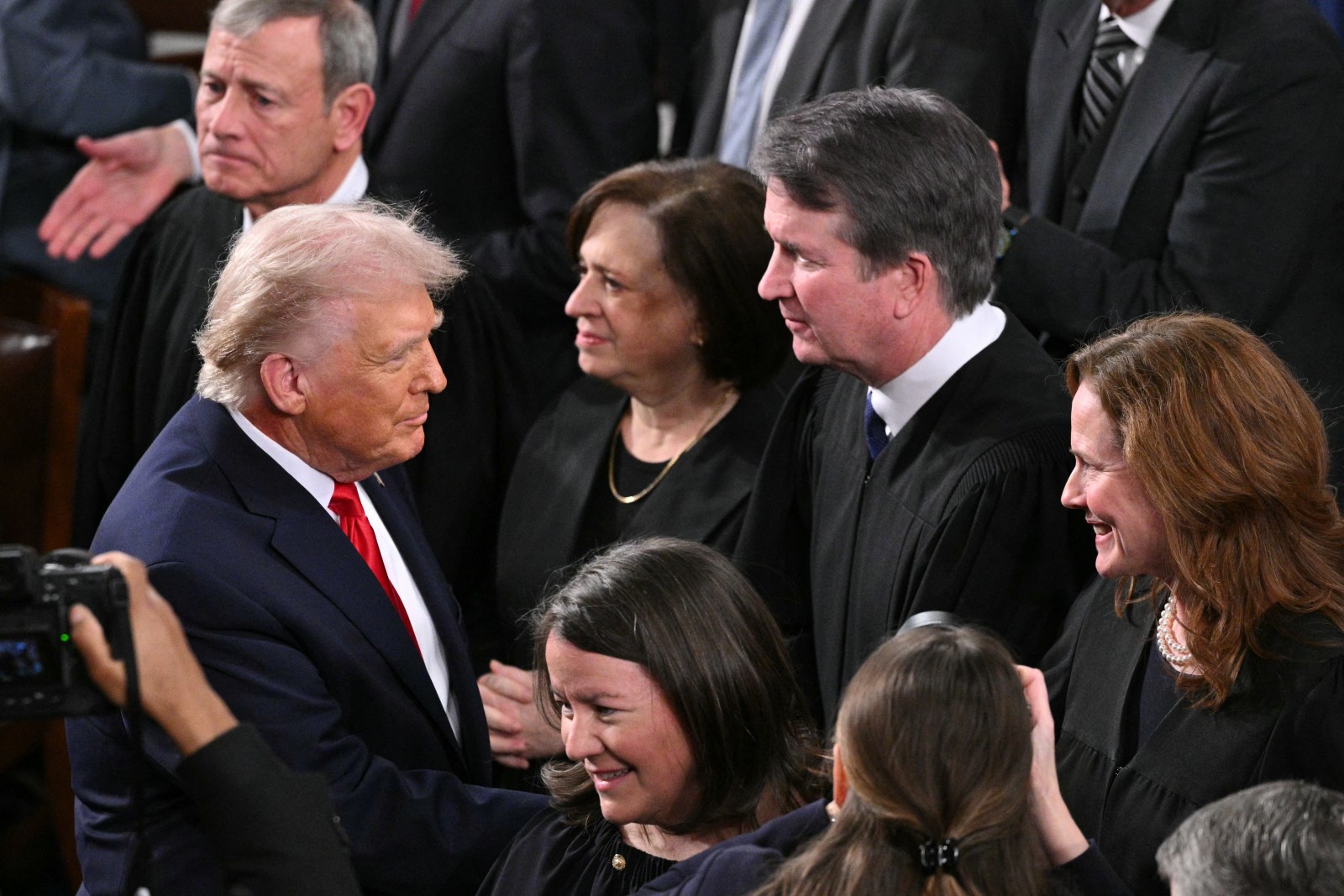
A recent Economist/YouGov poll indicates that nearly half of registered voters believe that the Supreme Court favors President Donald Trump. This comes as Trump increasingly seeks the Court’s intervention on election-related matters as midterms approach.
Conducted from September 4-8, the poll surveyed 1,469 registered voters. Results show 44 percent think the Supreme Court is biased towards Trump, while 12 percent view it as biased against him. About 27 percent believe the Court is unbiased, and 18 percent remain unsure. The poll’s margin of error stands at 3.4 percent.
Partisan Perceptions
Perceptions differ markedly along party lines. Among those who supported former Vice President Kamala Harris in the 2024 presidential election, 81 percent say the Court is biased in Trump’s favor. Only 9 percent of Trump voters agree. Within the Democratic Party, 77 percent see pro-Trump bias, whereas 20 percent of Republicans believe the Court is biased against him. Nearly half of Republicans say the Court treats Trump fairly. Among independents, 44 percent think the Court favors Trump, 23 percent see it as fair, and 8 percent view it as biased against him.
Supreme Court’s Standing Decline
The poll also suggests a decline in the Supreme Court’s overall standing since earlier this summer. Fifty-six percent of registered voters disapprove of the Court’s performance, compared to 34 percent who approve. This is a slight increase in disapproval from an Economist/YouGov poll in July, where disapproval stood at 50 percent.
Many perceive the Court as more conservative, with those describing it as such increasing from 44 percent in July to 49 percent in the latest survey. The perception of the Court as liberal saw a minor rise from 9 percent to 10 percent.
Influence of Recent Rulings
The Supreme Court’s recent rulings have drawn scrutiny, particularly involving politically significant election disputes as midterms near. The Court declined to reinstate a Republican-backed congressional map in Missouri and made several other rulings affecting Trump and Republican campaigns. The divide over the Court’s ideological path and its connection with Trump suggests that future rulings may further influence public opinion of the judiciary.
According to the latest poll, 47 percent believe the Court’s recent rulings have overly empowered Trump. Thirty percent think the rulings delegate the right amount of power, while 8 percent believe they offer too little. Regarding adherence to the Court’s orders, 73 percent say the president should always comply, even if he disagrees. Eleven percent disagree, and 16 percent are uncertain. Notably, this question was posed to a random half of the poll respondents.
Views on Individual Justices
An earlier Economist/YouGov poll in July revealed varied opinions on individual Supreme Court justices. Justice Amy Coney Barrett was viewed favorably by 23 percent and unfavorably by 38 percent. Clarence Thomas had a 29 percent favorable and a 41 percent unfavorable rating. Chief Justice John Roberts was viewed favorably by 25 percent and unfavorably by 36 percent. Justice Ketanji Brown Jackson received a 34 percent favorable and a 26 percent unfavorable rating. Overall, the net favorability ratings of Justices Thomas, Barrett, and Kavanaugh declined compared to a poll conducted a year earlier, illustrating shifting public opinion regarding the Court.
For editorial comments on this story, contact Samantha Beech and Gray R. Thomas at Newsweek.