
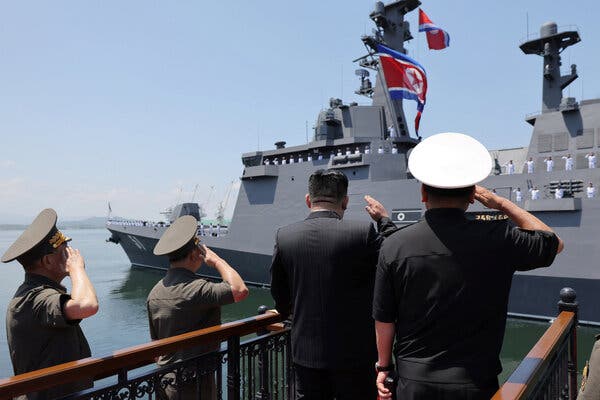
North Korea has taken a significant step in expanding its naval power with the commissioning of its largest warship, the Choe Hyon. This 5,000-ton destroyer, reported to carry nuclear-capable missiles, marks a new chapter in the country’s military capabilities.
This development came to light after North Korean state media released images of leader Kim Jong-un attending the commissioning ceremony at Nampo port. The event occurred on Tuesday, indicating the continuation of Kim’s ambition to enhance and nuclearize the nation’s navy.
During his speech, Kim announced the navy’s transition to a “full-fledged service.” He affirmed that their plan to equip the navy with nuclear weapons is progressing smoothly. This naval advancement is set against the backdrop of North Korea’s historical disadvantage compared to South Korea’s navy and U.S. fleets in the region.
The North Korean fleet, primarily composed of Soviet-era vessels, has previously been restricted to coastal operations. However, Kim’s expansion of naval capabilities aligns with his strategic cooperation with Russia. North Korea has supplied weapons and troops to Russia, supporting its conflict in Ukraine. In exchange, Russia is thought to provide oil, food, and military technology to update North Korean military assets.
Recent missile tests from the Choe Hyon have caught the attention of South Korean analysts. These tests included a supersonic cruise missile, seemingly incorporating Russian technology. This collaboration illustrates a shift in North Korea’s military strategy.
Traditionally, North Korea depended on ballistic missiles for its nuclear arsenal, as it lacked nuclear-capable aircraft or submarines. Under Kim’s leadership, the focus has shifted to navy nuclearization. This includes testing submarine-launched ballistic missiles, showcasing the hull of a nuclear-powered submarine, and developing unmanned underwater vehicles capable of carrying nuclear warheads.